
1. “Tax-Free” in the UK Is Not the Same Question as “Tax-Free” in the US
For many UK pension holders who move to the United States, the phrase “25% tax-free cash” creates a dangerous sense of certainty.
In the UK, the pension commencement lump sum is a familiar planning concept. Subject to scheme rules, available allowances, prior crystallisations and any protected rights, a member may be able to take part of their UK pension as a lump sum without UK income tax. In common speech, this is “tax-free cash”.
For a US-connected individual, that phrase should be handled with care.
The UK tax treatment of a pension commencement lump sum does not automatically determine its US federal income tax treatment. It does not settle state tax. It does not remove foreign asset reporting questions. It does not decide whether the payment should be treated as pension income, an annuity-type amount, a non-periodic pension distribution, a recovery of basis, or some other amount for US tax purposes. Nor does it answer whether the UK-US treaty can be relied upon by the particular taxpayer in the particular year.
That distinction is the central point of this article.
A UK pension does not become a US retirement account because its owner becomes US-resident. Equally, a UK tax exemption does not become a US tax exemption merely because the payment is described as “tax-free” by the UK scheme administrator.
For US residents with substantial UK pension assets, this article examines one of the most important cross-border retirement planning questions:
If I take a UK pension commencement lump sum while exposed to the US tax system, how will the payment be characterised, taxed, reported, timed and integrated into my wider wealth plan?
In particular, it examines what Articles 17 and 18 of the UK-US tax treaty do – and do not – protect, how the saving clause can affect the analysis, and why a payment that is tax-free in the UK may still require careful US tax and reporting review.
That is a materially different exercise.
For the wider private-client framework on holding a UK pension while living in the United States, see [Article 1: Holding a UK Pension While Living in the United States: Tax, Treaty, Transfer and Family Considerations].
The common misconception
The common misconception is that Article 17 of the UK-US income tax treaty makes the UK 25% lump sum “tax-free in America”.
That is an over-reading.
Article 17 is highly relevant. Article 18 is also relevant in certain pension contexts. But neither article should be read as a casual, blanket exemption for every UK pension event. The treaty must be read as a whole, including Article 1 and the saving clause. The taxpayer’s US status must also be understood: US citizen, green card holder, resident alien, treaty non-resident, dual-resident individual, or non-resident alien.
Those categories are not technical decoration. They can change the answer.
A UK national temporarily living in the US on a visa, a US citizen who has inherited UK pension rights, a green card holder planning to return to Europe, and a dual-resident executive taking treaty positions may all hold the same type of UK pension. Their US analysis may still differ.
The more sophisticated reality
The more sophisticated reality is that the UK lump-sum decision sits at the intersection of several regimes:
- UK pension legislation;
- UK scheme rules;
- UK income tax treatment;
- the UK-US treaty;
- the treaty saving clause;
- US domestic tax rules;
- US state tax;
- foreign asset and foreign trust reporting;
- exchange-rate timing;
- estate and beneficiary planning; and
- the client’s broader pension strategy.
A well-run analysis therefore begins before the pension instruction is submitted. Once the lump sum has been paid, the client may have converted a pension-planning question into a tax reporting, liquidity, reinvestment and succession issue.
That does not mean the lump sum should not be taken. For some clients, it may be entirely rational: to fund US expenditure, reduce future UK pension exposure (which my US clients will tell you, is an IRS pain), diversify currency, simplify provider risk, or align with retirement cash-flow planning.
But it should not be taken merely because the UK scheme permits it.
For a US-connected client, the UK scheme’s ability to pay a lump sum is only the starting point. More important is whether the member’s US tax residence, treaty position, basis records, reporting obligations, state tax exposure and broader family planning objectives make the timing and structure of the withdrawal appropriate.
This article focuses on the treaty issue behind that decision: what Articles 17 and 18 do – and do not – protect.
2. The UK Starting Point: What the 25% Pension Commencement Lump Sum Actually Is
Before analysing the US tax treaty, it is necessary to define the UK payment.
The 25% “tax-free cash” is not simply a withdrawal from an investment account. It is a UK pension commencement lump sum, usually connected to the crystallisation of pension benefits.
In UK pension terminology, “crystallisation” is the point at which pension benefits are formally accessed or designated for payment, triggering the conversion of part of the pension from an accumulated retirement fund into benefits that can be drawn. This may involve taking a lump sum, moving funds into drawdown, purchasing an annuity, or a combination of these steps, depending on the scheme and the member’s choices.
The amount available depends on UK pension rules, the scheme’s governing documentation and the member’s history.
For a straightforward UK-resident retiree, the practical explanation is often simple enough: part of the pension can be taken as cash without UK income tax, with the balance used for drawdown or other pension income.
For a US-resident or US citizen, that explanation is incomplete.
The US tax analysis does not begin with the marketing label “tax-free cash”. It begins with the legal and factual character of the payment. What type of pension is paying it? Is it an occupational scheme, a personal pension, a SIPP, or a defined benefit arrangement? What contributions funded it? Were those contributions made by the employee, employer, or both? Were any contributions previously taxed in the US? Have there been historic transfers, consolidations or crystallisations? Has the member already taken benefits? Does the scheme have protected lump-sum rights?
The UK facts matter because they define what the US adviser is analysing. This is particularly important because many otherwise highly competent US tax advisers, financial planners and retirement specialists have limited experience with UK pension arrangements. Their expertise may be extensive within the US retirement system, but they may never have analysed a UK defined benefit scheme, SIPP, pension commencement lump sum, protected tax-free cash entitlement or the interaction between UK pension legislation and the UK-US treaty. As a result, assumptions that are reasonable in a purely domestic US context can sometimes produce incomplete conclusions when applied to UK pension assets. For internationally mobile families, establishing the UK pension facts clearly at the outset is often the foundation of obtaining reliable US advice.
So, a payment from a UK defined benefit scheme may be documented differently from a payment from a SIPP. A pension with historic employer contributions may raise different basis questions from one funded largely by after-tax employee contributions. A pension consolidated from several UK schemes may have weaker records than one held with the same provider for decades. A pension with protected lump-sum rights may produce a UK result that is not obvious from a standard 25% calculation.
For high-net-worth clients, these details are not administrative clutter. They form the evidential foundation of the US tax position and, where a treaty benefit or favourable treatment is being claimed, may need to withstand detailed IRS scrutiny. The IRS will generally expect a well-supported technical analysis, supported by contemporaneous records, contribution histories, scheme documentation and a clear explanation of the taxpayer’s position.
Why UK Pension Mechanics Still Matter for US Tax, Treaty and Reporting Analysis
UK pension mechanics still matter because the treaty analysis is not conducted in the abstract.
A US tax preparer or cross-border tax counsel will typically need to understand what was actually paid. That may require reviewing:
- pension type;
- scheme jurisdiction and administrator;
- crystallisation statements;
- payment statements;
- contribution history;
- employer funding history;
- historic transfers;
- prior benefit access;
- protected lump-sum rights;
- UK tax deducted, if any;
- exchange-rate records; and
- prior US reporting.
This is especially important for clients who have held UK pensions across multiple career stages: UK employment, expatriate assignments, US relocation, business sale, semi-retirement, and eventual estate planning.
For example:
- A former London banker who spent part of his career in New York may hold a mixture of UK workplace pensions, a SIPP, and legacy US retirement assets such as a 401(k), accumulated across multiple employers over several decades. Historic transfers, employer contributions in different jurisdictions, and incomplete records of prior contributions can make it essential to establish basis, contribution history and prior tax treatment before taking a UK pension lump sum.
- A dual US-UK citizen living in California may receive a pension commencement lump sum from a UK defined benefit scheme. The treaty analysis, saving clause implications and California state tax treatment may all need separate review.
- A British executive who moved to the US five years ago may have accumulated pension rights in the UK, worked in Ireland, transferred benefits from an Irish defined contribution pension arrangement into the UK, and consolidated several schemes before relocating. Understanding the pension’s history may be essential to determining the correct US reporting and tax position.
The UK pension may have been accumulated in one country, governed in another, reported in a third, and drawn while the client is resident in the United States. Treating that as a generic “25% tax-free” event is rarely adequate.
A serious review should normally establish the UK facts first, then test the US and treaty consequences.
| UK fact to establish | Why it matters for US analysis | Evidence to collect |
| Pension type | Different schemes may produce different payment documentation and reporting questions | Scheme booklet, provider confirmation, pension statements |
| Lump-sum entitlement | Determines what the UK scheme can pay and on what basis | Crystallisation statement, benefit quotation |
| Prior crystallisations | May affect remaining lump-sum allowance and payment history | Historic benefit statements |
| Employee contributions | May be relevant to basis or investment-in-contract analysis | Payroll records, contribution schedules, tax returns |
| Employer contributions | May affect US taxable amount and prior inclusion analysis | Employer pension records, payslips, scheme statements |
| Historic transfers | Can obscure contribution history and prior tax treatment | Transfer documents, ceding scheme records |
| Prior US reporting | May affect consistency and disclosure | Prior Forms 1040, 8938, FBAR, 3520/3520-A if applicable |
| Scheme payment statement | Establishes what was actually paid and when | Provider distribution statement, bank records |
This is also where the wider pension strategy begins to matter. A client considering whether to take the 25% cash, leave the pension intact, enter drawdown, or analyse transfer options should not separate the tax-free cash question from the broader keep/draw/transfer decision. That decision framework is addressed in [Article 4: Keep, Draw or Transfer a UK Pension While Living in the US].
Why the UK “Tax-Free Cash” Label Is Not Conclusive for US Tax Treatment
The phrase “tax-free cash” is a UK domestic tax label. It does not bind the IRS.
The US may approach the payment through a different tax framework from the UK. Rather than asking simply whether the lump sum is tax-free under UK pension rules, the US analysis may focus on the gross amount distributed, whether any portion represents the taxpayer’s own previously taxed contributions (often referred to as basis or investment in the contract), the application of any relevant treaty provisions, and the taxpayer’s particular US tax status. As a result, a payment that is wholly or partly exempt from UK income tax can still require a separate US tax analysis. Conversely, the fact that a UK provider does not issue a US Form 1099 does not mean the payment is irrelevant for US tax purposes.
This is a common trap. UK pension administrators generally have no obligation under UK pension rules to analyse, monitor or report a member’s US tax position. Their role is to administer the pension in accordance with UK law and scheme requirements, not to determine how the IRS will treat a distribution. As a result, many providers simply do not focus on US reporting consequences, because there is nothing in the UK regulatory framework that requires them to do so. The absence of US tax paperwork, US tax commentary or US-specific guidance from the pension provider should therefore not be read as confirmation that there is no US tax issue.
For older UK pensions, the practical difficulty is often evidential. The client may have a current pension statement showing the fund value, but not a clean record of historic employee contributions, employer contributions, transfers and prior taxation. That matters because the US taxable amount may turn on what has already been taxed or contributed from after-tax funds.
There is also a practical reporting and transparency consideration. A UK pension is typically held through a trust structure, with legal ownership resting with the pension trustees rather than the member personally. While the member is the ultimate beneficiary, the pension itself does not always present the same visibility profile as a personal bank account holding cash. Once a substantial pension commencement lump sum is paid out, however, the position changes materially.
For example, a £500,000 pension fund might generate a pension commencement lump sum of approximately £125,000. At prevailing exchange rates, that could represent a transfer of roughly US$160,000-170,000 into a US bank account. For many individuals, that is a highly visible cross-border movement of funds. The receipt may attract attention from banks, compliance teams, tax preparers and reporting systems in a way that assets remaining within the pension structure may not.
This does not mean that receiving the lump sum creates a tax problem in itself, nor does it imply that pension assets escape US reporting considerations while held within the scheme. Rather, it highlights why documentation, source-of-funds records, treaty analysis and reporting positions should ideally be established before the distribution is made. Once a six-figure dollar amount arrives in a US account, questions about its origin, tax treatment and reporting history are often easier to answer if the supporting analysis has already been completed.
For substantial pension pots, reconstructing those records before taking the lump sum is usually more efficient than trying to defend the position after the distribution has been made.
3. Article 17 UK-US Tax Treaty: How Pension Income and Lump-Sum Distributions Are Taxed
Article 17 is the treaty provision most often cited in discussions of UK pensions and US residence.
It deals with pensions, social security, annuities, alimony and child support. In broad terms, it allocates taxing rights over pension payments between the United Kingdom and the United States. It is therefore central to the treatment of UK pension distributions received by US-connected individuals.
The key treaty language is worth understanding directly.
Article 17(1)(a) of the UK-US Income Tax Treaty provides, in substance, that pensions and other similar remuneration beneficially owned by a resident of one Contracting State are taxable only in that State. In practical terms, regular pension income paid from a UK pension to a US resident will often fall within this provision, subject to the wider treaty framework.
More importantly for the purposes of this article, Article 17(2) states:
“Notwithstanding the provisions of paragraph (1) of this Article, a lump-sum payment derived from a pension scheme established in a Contracting State and beneficially owned by a resident of the other Contracting State shall be taxable only in the first-mentioned State.”
This is the wording that attracts attention from UK pension holders living in the United States.
Read in isolation, the provision appears straightforward. A lump-sum payment from a pension scheme established in the United Kingdom and received by a US resident is taxable only in the United Kingdom. Since the UK pension commencement lump sum is generally exempt from UK income tax under UK domestic pension rules, many individuals conclude that the payment must therefore be tax-free everywhere.
That is the point at which the analysis often goes wrong.
The treaty wording itself is relatively clear. The difficulty arises because Article 17(2) cannot be read in isolation from the rest of the treaty. In particular, it must be considered alongside Article 1(4), the treaty’s saving clause, which generally preserves the right of the United States to tax its citizens and certain residents as though the treaty had not entered into force, subject only to specified exceptions set out elsewhere in Article 1.
The analysis should also take account of the accompanying Protocol and Treasury Technical Explanation, which provide important context on how the pension provisions interact with the saving clause.
The Protocol and the US Treasury Department’s Technical Explanation are particularly important because they address a question that Article 17(2), read on its own, does not answer: whether a US citizen or other person protected by the saving clause can still rely on the exclusive taxing-rights language for a UK pension lump sum.
The Treasury Technical Explanation to the UK-US Treaty states that Article 17(2) was designed to provide special treatment for pension lump sums and help prevent double taxation where the UK and US might otherwise apply different domestic rules. However, it also makes clear that Article 17 cannot be read in isolation and must be considered alongside Article 1, including the treaty’s saving clause.
This is where many simplified explanations become incomplete. The fact that Article 17(2) may refer to a payment being “taxable only” in one state does not end the analysis. The treaty, Protocol and Technical Explanation all require consideration of whether the saving clause preserves US taxing rights for the particular taxpayer. For US citizens, green card holders and certain other US taxpayers, the critical question is not simply what Article 17(2) says, but whether the treaty exception survives when read together with the saving clause.
My own reading of the treaty, the Protocol and the Technical Explanation is that Article 17(2) can often support favourable treatment for the UK pension commencement lump sum, including the familiar 25% tax-free cash. However, reasonable advisers disagree, largely because Article 1 and the saving clause introduce genuine interpretative complexity for US taxpayers.
As such, for many US citizens and certain other US taxpayers, those provisions can materially affect whether Article 17(2) delivers the result that a casual reading might suggest.
Accordingly, while Article 17(2) is unquestionably the starting point for analysing a UK pension commencement lump sum received by a US resident, it is rarely the end of the analysis.
But Article 17 is frequently misunderstood when its lump-sum provisions are read in isolation. Like any treaty article, it must be interpreted within the wider treaty framework, including definitions, exceptions, protocols and the saving clause, all of which can materially affect the outcome for US-connected individuals.
Periodic Pension Income vs Lump Sum Pension Withdrawals: Why the Difference Matters for US Tax Planning
Periodic pension income and pension lump sums should not be treated as the same planning issue.
A client taking regular pension income from a UK scheme is asking one type of treaty and domestic tax question. A client taking a single large pension commencement lump sum is asking another.
That distinction matters for several reasons.
First, the treaty itself distinguishes certain pension payments from lump sums. Article 17(2) is commonly cited because it deals specifically with lump-sum payments from pension schemes. Secondly, US domestic tax rules can treat periodic and non-periodic pension distributions differently. Thirdly, the timing impact of a lump sum can be materially more significant than regular drawdown, particularly for clients with concentrated income in the same year.
A US-resident founder selling a business, an executive vesting RSUs, or a partner receiving a large carried-interest distribution may not want a UK pension lump sum landing in the same US tax year without careful modelling. The treaty question is important, but so is timing.
There may also be UK administration points. PAYE coding, including applying for NT codes where appropriate, UK withholding and treaty claims can still require attention, even where the final treaty analysis is favourable. That is not the focus of this article, but it should not be ignored in implementation.
The practical point is straightforward: do not use the treaty treatment of regular pension income as a proxy for the treatment of a lump sum.
Article 17(2) and UK Pension Lump Sums: Does the US-UK Tax Treaty Protect the 25% Tax-Free Cash?
Article 17(2) sits at the heart of the analysis because it is the treaty provision that specifically addresses lump-sum distributions from pension schemes-and it is often the starting point for both the strongest planning opportunities and the most costly misunderstandings.
At a high level, the provision can point towards taxation of a pension lump sum in the state where the pension scheme is established. For a UK pension, that appears attractive: the scheme is UK-established, and the UK may treat the pension commencement lump sum as tax-free under domestic rules.
This is where many casual analyses stop.
They should not.
Article 17(2) is an allocation rule. It must be read alongside the saving clause. It must also be tested against the taxpayer’s status. The result may differ depending on whether the individual is a US citizen, green card holder, resident alien, treaty non-resident, or non-resident alien.
The most problematic reading is: “Article 17(2) says the UK has exclusive taxing rights, therefore the US cannot tax my UK lump sum.”
For a US citizen or green card holder, that conclusion is generally too confident. The United States taxes its citizens and certain residents on worldwide income, and the treaty saving clause can preserve that taxing right unless the relevant treaty provision is specifically excepted. Article 17(2) is particularly sensitive because it is not safely analysed as a stand-alone exemption for US persons.
The correct planning posture is not to assume that Article 17(2) fails, nor to assume that it succeeds. The correct posture is to identify the taxpayer’s status, residence position, scheme facts, and disclosure requirements before the payment is made.
A non-US citizen who is not a green card holder and who has a particular treaty residence position may be in a different position from a US citizen permanently resident in California. A dual-resident individual claiming treaty non-resident status may require a different analysis again. These distinctions are often where the real answer lies.
What Article 17 helps with – and what it does not decide
Article 17 helps identify the treaty framework for pension payments. It does not, by itself, settle every connected issue.
| Issue | Article 17 relevance | Separate issue still to verify |
| Periodic pension income | Central treaty provision for pension income | US status, residence, foreign tax credit position, reporting |
| Pension lump sum | Article 17(2) is central to the lump-sum analysis | Saving clause, taxpayer status, state tax, disclosure |
| UK withholding | May support treaty claims or reclaims | UK PAYE process, provider administration, timing |
| US federal tax | Treaty may affect taxing rights | Saving clause and domestic US rules |
| State tax | Treaty may not settle the state answer | State residence and conformity with federal treaty treatment |
| Reporting | Treaty may affect taxation, not necessarily reporting | Form 8938, FBAR, Form 8833, foreign trust reporting, as applicable |
| Basis | Article 17 does not reconstruct cost | Contribution records, prior taxation, investment-in-contract analysis |
For sophisticated clients, the Article 17 analysis should therefore be treated as one part of a broader pre-distribution review.
The treaty may be highly relevant. It may materially improve the position. It may support a filing position. But it is not a substitute for checking US status, state exposure, reporting and records.
This is why the lump-sum question should eventually feed into the wider keep/draw/transfer framework rather than being answered in isolation. For a detailed analysis of how to evaluate whether to retain a UK pension, begin drawdown, or explore transfer options after moving to the United States, see Article 4: Keep, Draw or Transfer a UK Pension While Living in the US.
4. The Saving Clause and UK Pension Lump Sums: Why the US Tax Answer Can Change for US Residents and Citizens
The saving clause is the provision that many non-specialist pension discussions miss.
In simple terms, the saving clause generally allows the United States to tax its citizens and certain residents as if parts of the treaty had not come into effect. That is not a footnote. It is often the technical centre of the US answer.
The UK-US treaty contains exceptions to the saving clause, but not every article is excepted. That distinction matters. A treaty benefit that appears available from one article may be limited if the saving clause preserves US taxing rights for the particular taxpayer.
The relevant provision is Article 1(4) of the UK-US Income Tax Treaty, commonly referred to as the saving clause. It provides:
“Except to the extent provided in paragraph 5 of this Article, this Convention shall not affect the taxation by a Contracting State of its residents (as determined under Article 4 (Residence)), and its citizens.”
In practical terms, this means that, unless a specific treaty provision is listed as an exception in Article 1(5), the United States generally retains the right to tax its citizens and residents under its domestic tax rules as though the treaty had not entered into force.
This is the provision that creates much of the complexity surrounding UK pension commencement lump sums.
A taxpayer reading Article 17(2) in isolation may conclude that a lump-sum payment from a UK pension scheme is “taxable only” in the United Kingdom. However, Article 1(4) requires a second question to be asked:
Is Article 17(2) one of the treaty provisions that survives the saving clause for US citizens and US residents?
That question is critical because Article 1(5) contains a limited list of exceptions to the saving clause. Certain treaty benefits remain available even to US citizens and residents because they are specifically carved out from Article 1(4). Other treaty provisions do not receive that protection.
The technical debate surrounding UK pension commencement lump sums largely arises from the interaction between Article 17(2), Article 1(4), Article 1(5), the accompanying Protocol and the Treasury Technical Explanation. The issue is not whether Article 17(2) exists – it clearly does. The issue is whether a US citizen or other taxpayer subject to the saving clause can rely upon Article 17(2) to prevent US taxation of a UK pension lump sum.
This is why experienced cross-border advisers rarely stop their analysis at the words “taxable only in the United Kingdom”. The treaty itself requires a further examination of whether the saving clause preserves US taxing rights for the particular taxpayer and whether any applicable exception removes that result.
Put differently, Article 17(2) tells you where the treaty initially allocates taxing rights. Article 1(4) determines whether the United States nevertheless reserves the right to tax the payment because the recipient is a US citizen or resident. The interaction between those two provisions is often the decisive issue in the analysis of UK pension lump sums received by US-connected individuals.
The treaty must be read with the saving clause, not instead of it.
Why US Citizens and Green Card Holders Need Special Care When Taking UK Pension Tax-Free Cash
US citizens are generally taxed by the United States on worldwide income, regardless of where they live. However, the analysis should not focus solely on citizenship. Many cross-border pension issues apply to “US persons”, a broader category that can include US citizens, green card holders, US tax residents under the substantial presence test, and in some contexts other individuals or entities with a sufficient connection to the US tax system. Green card holders may be US tax residents even where their personal, business or family life is internationally mobile. Other individuals may become US resident aliens under the substantial presence test, despite not considering themselves permanently based in the United States.
Importantly, these rules are not displaced merely because the pension is UK-based.
For a US citizen living in the United States, the saving clause is usually central. For a green card holder, it may be central. For a resident alien, it may be central. For a dual-resident individual claiming treaty non-resident status, the position requires careful treaty analysis and may involve disclosure. For US-connected individuals, the saving clause will often be a decisive part of the analysis and cannot be ignored when assessing the US treatment of a UK pension lump sum.
The categories matter because “US resident” is not a single planning profile.
A British entrepreneur who recently relocated to Miami under a visa arrangement, a dual US-UK citizen retiring in New York, a green card holder planning to move to Portugal, and a non-US executive temporarily seconded to Texas may all describe themselves as “US-based”. Their tax status may not be the same.
This is why the first planning question should be factual:
What is the individual’s US tax status in the year the lump sum is received?
Only after answering that should the treaty analysis be finalised.
It is also important to separate tax residence from immigration status. A visa category does not, by itself, determine federal tax residence. A green card carries its own tax residence consequences. Physical presence can create US residence even where the individual regards the US stay as temporary. A treaty tie-breaker may alter the US tax computation for some individuals, but it does not make the saving-clause issue disappear automatically.
Where a treaty-based return position is taken, the disclosure route should be considered carefully. In some cases, Form 8833 may need review. The point is not that every UK pension lump sum requires the same form. The point is that a material treaty position should not be improvised after the event.
Can US State Taxes Apply to UK Pension Lump Sums? Why State Tax Still Matters
Even where the federal treaty position is understood, state tax can remain relevant.
US states do not always approach treaty positions in the same way as the federal system. In particular, some states do not give full effect to provisions of US income tax treaties when calculating state taxable income, even where a treaty benefit is recognised for federal tax purposes. Some may tax residents on income that the client assumed had been dealt with at federal level. The answer can depend on the state, the taxpayer’s residence, the timing of the payment and whether the state conforms to the relevant federal treatment.
The position is further complicated because states take markedly different approaches to federal tax treaties.
States commonly regarded as not recognising federal treaty benefits for state income tax purposes
The following states are commonly cited as not allowing federal treaty benefits to eliminate state income tax exposure:
- Alabama
- Arkansas
- California
- Connecticut
- Hawaii
- Kansas
- Kentucky
- Maryland
- Mississippi
- Montana
- New Jersey
- North Dakota
- Pennsylvania
For a UK pension holder resident in one of these jurisdictions, a favourable federal treaty position does not necessarily eliminate state tax exposure. California is a common practical example: a UK pension lump sum that receives favourable federal treaty treatment may still require separate California tax analysis.
States with no broad individual income tax
In the following states, the treaty question is generally less relevant from a state income tax perspective because there is no broad state individual income tax:
- Alaska
- Florida
- Nevada
- New Hampshire
- South Dakota
- Tennessee
- Texas
- Washington
- Wyoming
This does not mean there are no state-level taxes at all. For example, other taxes, local taxes, business taxes, gross receipts taxes, or state-specific capital gains rules may still be relevant depending on the facts.
States commonly cited as expressly recognising federal treaty treatment
The following states are commonly cited as expressly recognising federal treaty treatment for state income tax purposes:
- Massachusetts
- South Carolina
- Virginia
Even in these states, the precise position should be verified for the relevant tax year, the type of pension payment, and the taxpayer’s filing position.
Other states requiring specific state-by-state analysis
For the remaining states, the result may depend on the state’s conformity to federal taxable income or federal adjusted gross income, specific statutory modifications, administrative practice, and the type of income involved. These states should not be assumed to reject treaty treatment, but nor should treaty treatment be assumed without checking the relevant state rules:
- Arizona
- Colorado
- Delaware
- Georgia
- Idaho
- Illinois
- Indiana
- Iowa
- Louisiana
- Maine
- Michigan
- Minnesota
- Missouri
- Nebraska
- New Mexico
- New York
- North Carolina
- Ohio
- Oklahoma
- Oregon
- Rhode Island
- Utah
- Vermont
- West Virginia
- Wisconsin
Accordingly, the correct approach is to first determine the federal treaty position, and then separately test whether the relevant state conforms to, modifies, or disregards that federal treatment. This is particularly important for lump sum pension payments, drawdown events, or cases involving a change of residence shortly before or after the pension payment.
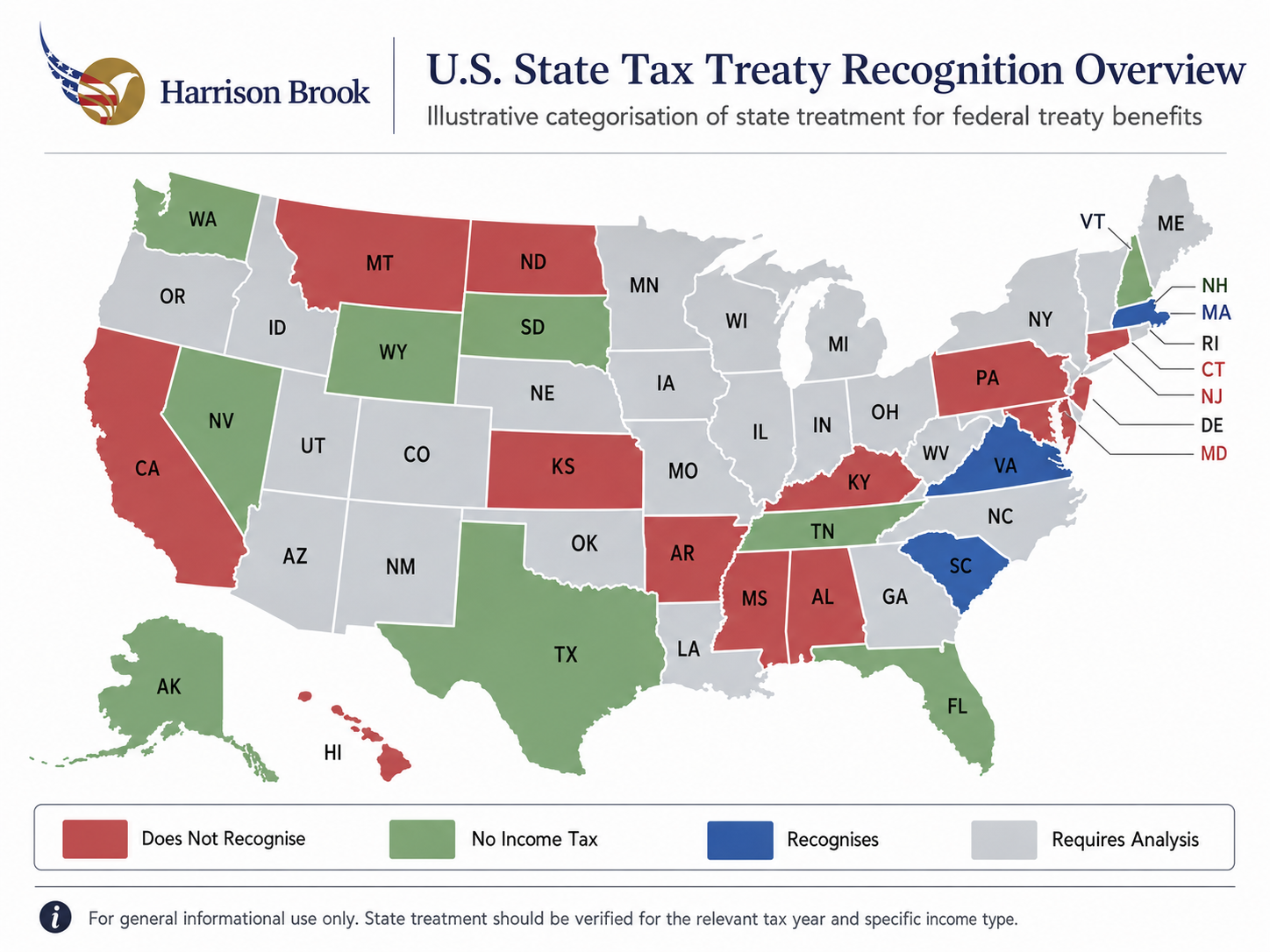
The practical lesson is straightforward: never assume that a favourable federal treaty outcome automatically determines the state tax result. For UK pension lump sums, state residence can be just as important as the treaty itself.
As such, for high-net-worth clients, this can be significant.
A large UK pension commencement lump sum taken while resident in a high-tax state may produce a different result from the same payment taken after a genuine and completed move to a lower-tax state. But state moves should not be treated casually. Residence is not changed merely by signing a lease, spending a few weeks elsewhere, or opening a bank account. State tax authorities may examine domicile, day count, property, family location, business ties, driver’s licence, voter registration, club memberships, medical providers and other evidence of real life.
The pension decision therefore needs to be coordinated with your wider US residence profile.
Moving states shortly before or after a lump sum should be analysed, documented and commercially credible. A pension withdrawal should not be allowed to drive a weak residence story. For internationally mobile families, the facts that matter for state tax are often the same facts that matter for school planning, business management, property ownership, healthcare, family governance and succession.
Before a UK lump sum is requested, US-connected clients should normally have the treaty position, saving-clause exposure, state residence and reporting route reviewed together. A technically correct UK pension instruction can still create an unexpected US tax result.
What Is the Practical Implication for US Residents Taking UK Pension Lump Sums?
The saving clause does not mean that every UK pension lump sum is taxed in the same way by the United States. It does mean that the analysis cannot stop at the words “taxable only in the UK”.
For serious clients, the order of operations should be:
- identify the UK pension and the nature of the proposed payment;
- confirm the member’s US tax status in the year of payment;
- analyse Article 17 and the lump-sum provision;
- read that analysis with Article 1 and the saving clause;
- consider whether any treaty-based return position or disclosure is needed;
- test state tax exposure separately;
- review reporting obligations; and
- decide whether the lump sum fits your investment, liquidity and family plan.
That sequence is less convenient than a one-line treaty answer. It is also more reliable.
For UK pension holders with relatively modest balances, the cost of a full cross-border review may, in some cases, outweigh the practical benefit. However, once UK pension assets exceed approximately £100,000, the sums involved are often large enough to justify at least a targeted analysis of the US tax, treaty and reporting position before benefits are accessed.
In practice, specialist cross-border advice frequently carries fees in the region of 1% to 3% of assets reviewed or implemented, with minimum engagements commonly starting at around £3,000. The economics therefore depend on the size of the pension, the complexity of the individual’s circumstances and the potential tax exposure.
For clients with UK pension assets exceeding £500,000, the analysis is typically fundamental rather than optional. At that level, treaty interpretation, saving-clause exposure, state tax, reporting obligations, beneficiary planning and withdrawal strategy can have material financial consequences. For clients with substantial UK pension assets, concentrated US income, state mobility, green card exposure, family succession concerns or future transfer plans, this work is often the difference between simply accessing pension benefits and implementing a coherent cross-border wealth plan.
If you hold substantial UK pension assets while living in the United States, specialist cross-border advice can help you make informed decisions with greater confidence. The interaction of treaty rules, US taxation, reporting obligations and retirement planning is complex. Harrison Brook’s UK-US specialists help internationally mobile individuals and families navigate these issues and assess whether taking tax-free cash aligns with their wider financial objectives.
5. Article 18 UK-US Tax Treaty: Contributions, Pension Growth and Why It Does Not Create a General Lump-Sum Exemption
Article 18 is the other treaty provision frequently misunderstood by UK pension holders living in the United States.
It is important. But it is narrower than many clients assume.
In broad terms, Article 18 deals with pension schemes themselves: contribution relief, participation in pension arrangements after cross-border moves, and the taxation of income, profits and gains accruing within qualifying pension schemes. It is relevant where an internationally mobile employee continues to participate in a pension scheme after moving between the UK and the US. It can also be relevant when considering whether income accumulating inside a recognised pension scheme should be taxed currently
The operative treaty language is often summarised, but the key provisions are worth seeing directly. Article 18(1) of the UK-US Income Tax Treaty provides:
“Where an individual who is a member or beneficiary of, or participant in, a pension scheme established in one of the Contracting States exercises an employment or self-employment in the other Contracting State, contributions paid by or on behalf of that individual to the pension scheme during the period that he exercises the employment or self-employment in the other State shall be deductible (or excludable) in computing his taxable income in that other State. Any benefits accrued under the pension scheme or contributions made to the pension scheme by or on behalf of the individual’s employer during that period shall not be treated as part of the employee’s taxable income and shall be allowed as a deduction in computing the profits of his employer in that other State.”
Article 18(2) then provides that, for purposes of determining an individual’s taxable income and an employer’s profits, “income earned by the pension scheme may be taxed as income of that individual only when, and, subject to paragraphs 1 and 2 of Article 17 (Pensions, Social Security, Annuities, Alimony, and Child Support), to the extent that, it is paid to, or for the benefit of, that individual from the pension scheme.”
In practical terms, these provisions are aimed at preserving pension contribution relief and preventing current taxation of pension accruals when an employee moves between the UK and the US and continues participating in a qualifying pension arrangement. They are not drafted as a general exemption for all future pension distributions, nor do they override the separate rules governing pension payments under Article 17.
However, Article 18 is not a universal shield around every UK pension event.
As we have established, it does not convert a UK pension into a US IRA or 401(k). It does not create a general right to roll UK pension money into a US retirement account on a tax-deferred basis. It does not automatically protect a transfer to a third-country pension arrangement. And it should not be treated as a blanket exemption for UK pension commencement lump sums.
That last point is particularly important.
A UK pension holder may read Article 18 and conclude that, because the treaty recognises pension scheme earnings or contribution relief in certain circumstances, the eventual lump-sum distribution must also be protected. That is not a safe conclusion. The treatment of inside growth while the pension remains intact is not the same question as the treatment of a distribution when money leaves the pension.
Article 17 and Article 18 answer different questions. Serious planning requires analysing them together within the wider US tax and treaty framework.
Inside Growth Is Not the Same as a Lump-Sum Distribution
While assets remain inside a UK pension, the tax analysis may focus on whether the arrangement is a treaty-recognised pension scheme, whether the member is currently taxable on undistributed income, whether foreign trust reporting applies, and whether any treaty or administrative relief is available.
This is also one of the key distinctions between UK pensions and other UK investment vehicles commonly held by expatriates, such as ISAs or general investment accounts (GIAs). In broad terms, and subject to the specific facts and any applicable reporting requirements, money held within a qualifying UK pension is generally able to grow without current taxation while it remains inside the pension.
That treatment is often one of the principal advantages of retaining assets within the pension wrapper. However, the fact that investment growth may accrue on a tax-deferred or tax-favoured basis inside the pension does not automatically determine how a later distribution will be taxed once funds are withdrawn.
Once money leaves the pension, the question changes.
A distribution requires analysis of the payment itself: gross amount, taxable amount, basis, treaty treatment, saving-clause exposure, state tax, foreign tax credits where relevant, and reporting. A UK pension commencement lump sum is therefore not merely the release of an asset already sitting inside a protected environment. It is an access event.
This distinction is often missed because UK pension language encourages clients to think in a single category: “my pension”. For US tax purposes, the position may be more granular.
There may be one analysis for income and gains accruing inside the pension. There may be another analysis for employee contributions. Another for employer contributions. Another for regular drawdown. Another for a lump sum. Another for a transfer. Another for beneficiary payments on death.
That fragmentation is inconvenient, but it is central to the planning.
A client with a large UK SIPP may reasonably ask: “If the US has not taxed the investment growth inside the pension each year, why would taking the 25% cash be different?”
The answer is that the US tax question changes when there is a distribution. At that point, the issue is no longer only whether internal accrual has been protected. It is whether the payment received by the taxpayer is taxable under US domestic rules, modified by the treaty where applicable, and whether the saving clause affects the treaty position.
This is also where basis becomes important. If the client made employee contributions while US-taxable and those contributions were not deductible for US purposes, some part of the later distribution may require a cost or investment-in-the-contract analysis. Conversely, where the pension was funded by employer contributions, pre-US employment, UK tax-relieved contributions or historic transfers, the analysis may be different.
For older pensions, the difficulty is often not conceptual. It is evidential. The client may not have clean records of contributions made 20 or 30 years earlier. A pension provider may be able to confirm current value and benefit options, but not the full tax history required for US purposes. Where a material lump sum is being considered, that record gap should be identified before the distribution is requested.
Contributions After Moving to the US
Article 18 can also matter for individuals who continue participating in a UK pension scheme after moving to the United States.
This is common among internationally mobile executives, partners, founders and senior employees who remain connected to a UK employer or group pension arrangement. It can also arise where a person relocates to the US but continues contributing to a UK personal pension or SIPP.
The treaty position is not uniform.
Article 18 may provide relief in defined circumstances, particularly where an individual was already participating in a pension scheme before moving to the other country and the arrangement broadly corresponds to a pension scheme in the new country of employment or residence. But this is not a general rule that every UK pension contribution made after relocation receives straightforward US tax relief.
Employer contributions, employee contributions and salary sacrifice arrangements may all need separate analysis. So may US payroll reporting, foreign tax credits, W-2 treatment, UK tax relief and whether the contributions later create basis for US purposes.
The planning issue is not merely whether contributions are “allowed” under UK rules. They may be allowed in the UK but still require a US analysis. For a US-resident taxpayer, continuing UK pension contributions without checking the US position can create a long-term record problem. Years later, when a lump sum or drawdown begins, the client may need to prove which contributions were previously taxed, which were not, and how the pension should be treated on distribution.
For senior executives, this is particularly important because pension decisions rarely happen in isolation. UK pension contributions may sit alongside RSUs, stock options, carried interest, deferred compensation, US qualified plans, non-qualified deferred compensation, foreign employer reporting and relocation tax support. The pension may be only one line item in a much larger cross-border compensation picture.
A mobile executive should therefore avoid assuming that Article 18 provides automatic symmetry between the UK and US systems. It does not. It is a treaty provision with conditions, definitions and limits.
Rollovers and Transfers Are a Different Question
Article 18 is also frequently misused in discussions about transfers.
A UK pension holder in the United States may ask whether they can transfer their UK pension into a US retirement account, a third-country QROPS, a Malta arrangement, or another offshore pension structure without current US tax. This is not the same question as taking the 25% pension commencement lump sum. It is a transfer question.
The treaty answer is different, and often less forgiving.
Article 18 should not be read as a general rollover safe harbour. A UK-to-US pension transfer must still be tested against US domestic rollover rules. A receiving arrangement in the United States does not automatically qualify merely because it is retirement-related. In many cases, a UK pension distribution paid into a US plan may not satisfy the domestic requirements for tax-deferred rollover treatment.
Third-country transfers raise a further issue. A pension scheme established outside both the UK and the US is not treated as a treaty-recognised pension scheme for purposes of the UK-US treaty. That distinction is fundamental. QROPS status is a UK transfer status. It is not a US tax classification. A scheme can appear on an HMRC-recognised overseas pension list and still fail to deliver the US treaty outcome the member expected. In practice, transferring a UK pension to a QROPS can result in the loss of treaty protection and trigger US taxation of the pension as income. Put bluntly, a transfer to a QROPS can amount to telling the IRS: “tax my pension as income.” This is not a theoretical concern. It has been the subject of scrutiny by senior IRS investigators and should be treated as a high-risk step for US-connected pension holders.
This is particularly relevant for Malta and other third-country structures, where older promoter material sometimes presented QROPS as a clean solution for US-connected pension holders. The modern position is far more cautious. A third-country pension transfer may change the treaty analysis, create a US taxable distribution, generate foreign trust reporting questions, and alter future beneficiary and estate outcomes.
Article 3 deals with QROPS, UK-to-UK transfers, UK-to-US transfers, third-country pension transfers and the US reporting consequences that sit outside the lump-sum question. For anyone considering a transfer, Article 2 should not be read as a transfer guide. It is a lump-sum and treaty analysis. The transfer question requires its own review.
If you are considering a UK pension transfer, QROPS arrangement or consolidation strategy while living in the United States, Harrison Brook’s FCA- and SEC-regulated planners can help assess tax, treaty and reporting implications before any transfer is completed.
Article 17 vs Article 18: The Practical Distinction
The safest way to read the treaty is to ask which question is actually being answered.
| Question | Article 17 relevance | Article 18 relevance | Common mistake |
| Regular UK pension income | Core provision for pension income | Usually secondary | Assuming the same analysis applies to lump sums |
| UK pension commencement lump sum | Article 17(2) is central | Does not create a general lump-sum exemption | Reading Article 17(2) without the saving clause |
| Inside growth within a UK pension | Usually not the main provision | Potentially relevant to scheme earnings | Assuming inside-growth treatment determines distribution treatment |
| Contributions after moving to the US | Usually not the main provision | Potentially relevant, but condition-dependent | Assuming all UK contributions receive US relief |
| UK-to-UK pension transfer | Relevant only indirectly | May be relevant if both schemes qualify | Ignoring scheme qualification and reporting |
| UK-to-US transfer | Not a standard pension income issue | Does not override US domestic rollover law | Assuming treaty language creates a US rollover |
| UK-to-third-country transfer | Treaty protection may be disrupted | Often highly sensitive | Treating QROPS status as a US tax answer |
| Reporting obligations | Treaty may affect tax treatment | May affect classification, but not a reporting cure-all | Assuming treaty protection removes Form 8938, FBAR or foreign trust review |
The practical conclusion is simple: Article 18 should be respected, but not stretched. It can be highly relevant to pension scheme earnings and contribution relief. It is not a general exemption for the 25% UK pension commencement lump sum, nor a universal solution for transfers.
For UK pension holders in the United States, the distinction between Article 17 and Article 18 is not academic. It determines whether the planning question is about pension income, lump-sum taxation, contribution relief, inside growth, transfer treatment, reporting, or all of them together.
6. UK Pension 25% Tax-Free Lump Sum: Practical US Tax Analysis Before Taking Pension Cas
The treaty analysis is necessary, but it is not sufficient.
For a US-connected client, the practical work should happen before the UK pension provider is instructed to pay the lump sum. Once the payment has been made, the tax character, reporting trail, exchange-rate evidence and state tax position may still be manageable, but the planning flexibility has already narrowed.
A pension commencement lump sum is not simply an administrative instruction. It is a taxable-year event, a liquidity event, a reporting event and often a family-wealth event.
The correct analysis begins with status.
Is the individual a US citizen? A green card holder? A resident alien under the substantial presence test? A dual-resident taxpayer claiming treaty non-resident status? A non-resident alien? Has the individual recently entered or left the United States? Is a green card being retained, surrendered or applied for? Is the client moving between states in the same year?
Those questions should be resolved before focusing on the pension itself. Tax residence determines whether the US system is engaged, whether the saving clause is relevant, whether treaty disclosure may be needed, and whether state tax analysis is required.
Only then should the pension facts be layered in.
The pension review should identify the type of scheme, the amount proposed for withdrawal, prior crystallisations, historic transfers, employee contributions, employer contributions, UK tax treatment, and the documents the scheme will provide. If the provider’s documentation is too generic, additional clarification may be needed before payment.
For high-value pensions, the client should also consider the wider income picture for the year. A lump sum received in the same year as a business sale, major bonus, RSU vesting, carried-interest receipt, property sale, severance package or relocation package may create a materially different outcome from the same lump sum received in a quieter tax year.
The pension question therefore becomes a sequencing question.
Before taking pension benefits, it can be valuable to obtain coordinated UK-US advice. Harrison Brook’s SEC- and FCA-regulated financial planners specialise in cross-border retirement planning, helping expatriates assess treaty implications, reporting obligations, withdrawal timing, investment strategy and long-term wealth planning so pension decisions support broader financial objectives.
Basis, Records and “Investment in the Contract”
One of the most practical issues in US pension taxation is basis.
In US terms, the taxable amount of a pension or annuity distribution may depend on the gross amount received less the taxpayer’s cost, often described as investment in the contract. Applied to a foreign pension, that can require reconstructing what part of the pension represents amounts previously taxed or contributed from after-tax income.
In simpler terms, the IRS generally does not want to tax the same money twice. If some of the money that went into your pension came from income that had already been taxed, that portion may not be fully taxable again when you take money out. The challenge with a UK pension is proving how much of the pension comes from previously taxed contributions and how much comes from untaxed contributions, employer funding, investment growth or other sources. To work this out, it may be necessary to review old contribution records and pension statements going back many years.
This sounds straightforward. In practice, it is often difficult.
A UK pension may have been built through decades of employment, employer contributions, employee contributions, salary sacrifice, transfers from prior schemes, contracted-out rights, overseas assignments and consolidation. The client may have moved to the US midway through the accumulation period. Some contributions may have received UK tax relief. Some may have been made while the individual was US-taxable. Some may have been included in US income. Some may not have been reported consistently at all.
The result is that two pensions with the same current value can produce different US tax analyses.
A £1 million UK pension funded entirely during UK employment before US residence is not the same evidential fact pattern as a £1 million pension funded partly through employee contributions while the member was US-resident and filing US tax returns. A defined benefit scheme does not produce the same record profile as a modern SIPP. A pension consolidated through several transfers may require more reconstruction than a single-employer scheme.
This is why old records matter.
You should ideally collect:
- annual pension statements;
- contribution histories;
- payroll records;
- employer contribution records;
- transfer statements;
- crystallisation statements;
- prior UK tax records;
- prior US tax returns;
- prior Form 8938 and FBAR filings, if applicable;
- any Forms 3520 or 3520-A previously filed or considered;
- exchange-rate records for historic contributions where relevant; and
- correspondence from the pension provider about the proposed payment.
The objective is not to create a perfect archive for its own sake. It is to support the US position. A treaty claim, basis calculation or reporting conclusion is stronger when it is supported by contemporaneous evidence rather than reconstructed under pressure after the funds have arrived.
For many clients, the practical problem is not that the US answer is impossible to determine. It is that the evidence needed to determine it was never assembled.
Timing: Why the Tax Year, State and Other Income Events Matter
The timing of a UK pension lump sum can materially affect the outcome.
For a US-connected client, the relevant timing questions include:
- What is the individual’s US tax status in the year of receipt?
- Is the client moving into or out of the United States?
- Is a green card being obtained, retained or relinquished?
- Is the client changing state residence?
- Is the client expecting a business sale, bonus, RSU vesting, carried-interest payment or other major income event?
- Will the lump sum be received before or after retirement?
- Will funds be needed in GBP, USD or another currency?
- Is the pension being reviewed as part of a future transfer strategy?
- Are beneficiary or estate planning changes expected?
These questions are not incidental. They can be determinative.
A large pension commencement lump sum taken during a high-income US tax year may be unattractive even where the treaty position is supportable. Even if the taxpayer has a credible treaty analysis, the distribution can still increase scrutiny, complicate reporting, interact with other income items, affect the availability or value of deductions and credits, and create uncertainty around the overall tax outcome for the year. Where the client is already recognising substantial income from sources such as a business sale, bonus, RSU vesting or investment gains, adding a significant pension event may make the year unnecessarily complex and increase the cost and risk of compliance.
A lump sum taken while resident in California may have a different state tax profile from one taken after a genuine and well-documented move to Florida or Texas. A lump sum taken shortly before a relocation away from the US may have a different risk profile from one taken after the client has clearly exited US tax residence, subject of course to citizenship, green card and treaty considerations.
Timing also affects foreign exchange.
A UK pension commencement lump sum will usually be calculated and paid in sterling. If the client’s expenditure is in US dollars, exchange-rate timing becomes part of the economic decision. The tax analysis may require translating amounts into US dollars at the appropriate exchange rate. The investment analysis may require deciding whether to convert immediately, phase conversion, retain sterling exposure, or match currency to future liabilities.
For clients with multi-currency lives, the pension decision should not be reduced to a UK tax question. The cash may be needed for US property, education funding, philanthropy, debt repayment, business liquidity, family support or portfolio rebalancing. Each use has its own tax, currency and succession implications.
The Lump Sum as a Wealth-Planning Event
A UK pension often has a particular estate and beneficiary profile. It may sit outside the client’s direct personal investment account. It may have scheme discretion, nominated beneficiaries and pension-specific death-benefit rules. It may also be affected by changing UK inheritance tax policy and the client’s US estate tax exposure.
Once a lump sum is withdrawn, it usually becomes ordinary personal capital. That can be helpful or harmful.
It may provide liquidity for US expenditure, reduce future UK pension complexity and allow investment management within a US-compliant portfolio. But it may also bring funds into the client’s personal estate, expose them to different creditor, divorce, investment, reporting or estate tax considerations, and change the family’s succession plan.
A pension fund left within the scheme and a cash sum held in a personal investment account are not equivalent family-wealth structures.
This is particularly important for clients with second marriages, children in different jurisdictions, US beneficiaries, UK beneficiaries, trusts, prenuptial arrangements, or philanthropic intentions. The lump sum may solve a pension problem while creating a family governance problem.
A serious analysis should therefore ask not only “how is the lump sum taxed?” but also “where does the money sit afterwards, who controls it, how is it invested, how is it reported, and what happens on death?”
Where the lump sum is material, the useful planning work is done before the pension instruction is submitted: status, treaty position, basis, timing, state exposure, liquidity needs and family consequences should be mapped together.
When Phased Access May Be Preferable
The UK 25% pension commencement lump sum is often discussed as though it must be taken in one decision. In practice, depending on the pension structure and scheme rules, phased crystallisation or staged access may be available.
For US-connected clients, phased access can sometimes be worth analysing.
It may allow the client to manage taxable-year exposure, align withdrawals with lower-income years, reduce state tax risk, coordinate with exchange-rate planning, or avoid creating an unnecessarily large cash balance in a personal account. Cash is generally a poor long-term store of value. See our guide to investing after a liquidity event. It may also allow further time to reconstruct records, clarify residence, or resolve a transfer analysis before making an irreversible decision.
Phasing is not always better. Some schemes have restrictions. Some clients need liquidity. Some protected lump-sum rights may be affected by the method of access. In other cases, taking the available lump sum at once may be administratively cleaner.
The point is not that phased access is inherently superior. The point is that the method of access should be chosen strategically, with a clear understanding of how it supports the client’s broader tax, investment and wealth objectives.
For a UK-resident retiree with a straightforward pension, the difference may be modest. For a US-connected client with substantial assets, state mobility, incomplete records and other income events, the difference can be material.
7. UK Pension Lump Sum Reporting, Pension Transfers and Tax Decision Consequences for US Residents: Why the 25% Tax-Free Lump Sum Is Not an Isolated Event
The 25% UK pension commencement lump sum is often treated as a pension-access decision.
For a US-connected client, it is more than that. It is also a reporting decision, a transfer decision, an investment decision and a family-wealth decision.
A lump sum may interact with US foreign asset reporting even where the client believes the treaty protects the payment from US federal income tax. Forms potentially requiring review may include Form 8938, FBAR, Forms 3520 and 3520-A, and Form 8833, depending on the pension structure, account values, taxpayer status, treaty position and reporting history.
These forms should not be presented as universal obligations. That would be inaccurate. But they should be treated as review points.
This distinction matters. A client may be right on the treaty issue and still have a reporting issue. Conversely, a client may have a reporting obligation even where no additional income tax is ultimately due. Treaty relief and reporting relief are not the same thing.
Rev. Proc. 2020-17 is a useful example. It may provide relief from certain foreign trust reporting obligations for eligible individuals with certain tax-favoured foreign retirement or non-retirement savings trusts. But it is not a blanket exemption for every UK pension, every foreign pension, or every reporting form. It does not eliminate Form 8938 or FBAR analysis. It does not turn a third-country pension structure into a safe arrangement. It is a specific administrative relief with conditions.
Why does this matter? Because foreign trust reporting errors can trigger exceptionally severe penalties, even when little or no additional tax liability exists. Forms 3520 and 3520-A have historically carried some of the harshest information-reporting sanctions in the US tax regime, with penalties often calculated by reference to asset values, distributions, or ownership interests.
These consequences can become disproportionately expensive relative to the underlying tax issue. A missed filing may result in penalties measured as a percentage of transfers, distributions, or trust assets, frequently starting at substantial levels and escalating if non-compliance persists. For example, foreign trust reporting failures can trigger penalties starting at the greater of $10,000 or a percentage-based amount tied to the transaction or trust assets, depending on the form involved and the nature of the non-compliance. Consequently, reporting exposure can sometimes outweigh the economic significance of the transaction itself.
For UK pension holders, this distinction is critical. The central question is not merely whether a pension distribution is taxable, but whether the arrangement creates foreign trust reporting obligations. While treaty provisions, administrative relief, or exemptions may apply, eligibility is highly fact-dependent and should be evaluated carefully before concluding that no filing requirement exists.
For high-net-worth clients, the reporting history can be as important as the current payment. If the UK pension has never been reported on Form 8938 or FBAR where it should have been, or if foreign trust reporting was never analysed, taking a large lump sum may bring historic uncertainty into sharper focus. That does not mean the client should panic. It means the reporting position should be reviewed before the distribution is made.
When Taking the Lump Sum May Be Worth Analysing
Taking the UK pension commencement lump sum can be entirely rational.
For some clients, retaining all assets inside a UK pension is not automatically optimal. The pension may be administratively awkward, investment options may be constrained, US reporting may be burdensome, the provider may not support US-resident clients properly, or the client may need liquidity in the United States.
Taking the lump sum may be worth analysing where:
- the client has a genuine liquidity need;
- the funds will be used for US property, education, debt repayment or family support;
- sterling exposure should be reduced, although this can often be achieved within an International SIPP that offers multi-currency investment and cash options;
- the client wants to simplify pension administration;
- the pension provider is restrictive for US residents;
- the lump sum can be timed in a lower-income year;
- state residence is favourable and properly established;
- basis records are strong;
- the treaty position is well-supported;
- future UK pension rule exposure is a concern; or
- the withdrawal supports a broader investment or estate plan.
A founder who has sold a UK business and now lives in the US may decide that drawing part of a UK pension to diversify currency and fund US lifestyle liabilities is sensible. A retired executive may use a lump sum to reduce reliance on a UK provider that offers limited service to US residents. A family with US education expenses may prefer planned liquidity over forced future withdrawals.
These are legitimate planning reasons.
But they are different from simply taking the lump sum because “it is tax-free”. The planning case should stand on its own after tax, reporting, currency and family implications have been tested.
When Deferring the Lump Sum May Be More Sensible
Deferral can be more sensible where the client’s position is unresolved.
Examples include:
- unclear US tax residence;
- pending green card decisions;
- a possible treaty non-resident position;
- incomplete contribution or basis records;
- an imminent move between US states;
- a high-income year caused by bonus, RSU vesting or business sale;
- unresolved UK tax coding or withholding issues;
- uncertain Form 8938, FBAR or foreign trust reporting history;
- pending divorce or family governance issues;
- planned relocation away from the United States;
- possible UK-to-UK or overseas transfer analysis;
- uncertain beneficiary nominations; or
- estate planning that has not been updated for the client’s current residence.
Deferral is not indecision. In many cases, it is risk control.
A client who expects to leave California for Florida in six months may not want to trigger a material pension distribution before the move is complete and defensible. A green card holder considering whether to retain or abandon that status should not treat the pension lump sum as a separate issue. A business owner in the year of sale may prefer to avoid adding a complex pension event to an already concentrated tax year.
The correct conclusion may still be to take the lump sum-but only after the timing has been considered as carefully as the decision itself.
For some clients, the best decision is to pause, reconstruct records, clarify residence, align the US and UK tax advisers, and revisit the pension instruction once the facts are cleaner.
When the Lump Sum Should Be Considered Alongside Transfer Analysis
The lump-sum decision should also be considered alongside any transfer analysis.
This is particularly important where the client is considering QROPS, a UK-to-UK pension transfer, consolidation into a different UK SIPP, or any third-country pension arrangement.
Taking the lump sum before a transfer may change the economics of the remaining pension. It may reduce the amount exposed to transfer risk. It may also alter available UK allowances, protected rights, provider options and future drawdown strategy.
Conversely, transferring before taking benefits may change the treaty analysis, reporting profile, UK overseas transfer charge exposure, investment platform and beneficiary framework. A third-country transfer can create a very different US tax and reporting position from leaving the pension inside the UK.
QROPS status should be treated with particular caution. It is a UK concept. It tells the member something about whether a receiving scheme may satisfy UK recognised overseas pension scheme requirements. It does not tell the member that the IRS will treat the structure favourably. It does not eliminate US reporting. It does not guarantee that Article 18 applies. It does not override domestic US tax rules.
For US-connected clients, the old “transfer to an offshore pension and solve the problem” narrative is no longer credible, if it ever was. The relevant question is not whether a structure has a pension label. It is whether the structure preserves the intended UK tax outcome, US treaty treatment, US reporting profile, investment governance and family wealth objectives.
Article 3 deals with QROPS, transfers and US reporting in detail. It should be read before any transfer decision is made. Article 4 then turns the variables into a practical keep, draw or transfer framework.
UK Pension Lump Sum Options for US Residents
For most UK pension holders living in the United States, the decision is not simply whether to take the 25% tax-free lump sum. The key question is whether taking benefits now, delaying access, phasing withdrawals or reviewing transfer options produces the best overall tax and financial outcome.
| Option | When it may be appropriate | Key issues to review |
| Take the lump sum now | Clear treaty position, strong records, genuine liquidity need, favourable timing | US tax treatment, state tax, reporting obligations, reinvestment strategy |
| Defer access | Uncertain US status, incomplete records, pending relocation, unusually high-income year | Future tax changes, provider restrictions, investment considerations |
| Phase withdrawals | Pension allows staged access and the client wants greater control over timing | Scheme rules, exchange rates, annual reporting requirements |
| Review transfer options | Considering pension consolidation, QROPS or another pension structure | UK transfer charges, US tax consequences, reporting obligations |
| Pause pending advice | Residence, treaty or immigration status remains unresolved | Documentation gaps, filing consistency, timing risks |
The right choice depends on the client’s wider financial position rather than the pension in isolation. A UK pension may sit alongside US investment accounts, UK property, business interests, trusts, retirement accounts and other cross-border assets.
As a result, a pension strategy that appears attractive on its own may not be the most efficient outcome when viewed as part of an overall wealth, tax and succession plan.
Final Conclusion: Is the 25% UK Pension Lump Sum Tax-Free in the US? The Better Question for UK Pension Holders Living in America
The UK pension commencement lump sum is one of the most misunderstood planning issues for UK pension holders living in the United States.
The UK allows part of the pension to be taken without UK income tax where the pension commencement lump sum rules are satisfied. Article 17 is central to the treaty analysis of the lump-sum payment. Article 18 governs separate issues relating to pension scheme earnings and contributions. But neither the UK tax treatment nor any single treaty provision provides a complete US answer.
The better question is not whether the UK permits the 25% lump sum. It is whether the client’s US tax position, treaty status, records, reporting obligations, timing and wider wealth plan make taking it a rational step.
For some clients, the answer will be yes. For others, the better answer will be to defer, phase access, resolve reporting first, wait for a state move, or consider the lump sum alongside a broader pension transfer review.
That is the distinction serious clients should care about.
A UK pension commencement lump sum is not simply a pension-access choice. For US-connected individuals and families, it is a tax, treaty, reporting, liquidity, investment and succession decision.
Harrison Brook’s FCA- and SEC-regulated planners provide coordinated UK-US retirement advice, helping expatriates navigate pensions, treaty issues, reporting obligations and wealth planning.
