
A UK pension can become one of the most complex assets a US resident owns-not because of the pension itself, but because every decision about it sits between two tax systems, two regulatory frameworks and often several future life scenarios.
As a result, many people approach the issue by asking a single question: should the pension be transferred out of the UK? But that framing is too narrow. It assumes the only meaningful choice is between leaving the pension untouched in the UK or moving it somewhere else. For internationally mobile families, senior executives, entrepreneurs and high-net-worth individuals with substantial UK pension holdings, the decision-making framework is far broader and requires a more rigorous, strategic assessment.
The consequences can affect taxation, reporting obligations, retirement income, estate planning and family wealth across multiple jurisdictions, which is why many US residents choose to obtain specialist cross-border advice before taking action. Harrison Brook offers a complimentary UK pension review for US residents.
You may need to keep the UK pension. You may need to draw from it. You may need to take partial benefits. You may need to consolidate several UK schemes. You may need to review a QROPS or overseas transfer. Or, in some cases, the most sophisticated answer may be to pause until the tax, treaty, reporting, liquidity and family facts are clearer.
The important point is that inaction and action both carry consequences. Leaving a UK pension alone is not automatically safe. Transferring it is not automatically efficient. Drawing the UK 25% pension commencement lump sum is not automatically tax-free in the United States. And a QROPS is not automatically a better structure simply because it appears more flexible.
A UK pension held by a US resident sits at the intersection of several different regimes: UK pension law, US federal tax, state tax, the UK–US tax treaty, foreign asset reporting, investment platform access, estate planning, beneficiary design and future residence. These do not always point in the same direction.
This article converts the technical issues into a practical decision framework: should you keep, draw, transfer, consolidate, review or pause?
For the broader private-client planning context, see our guide to [holding a UK pension while living in the United States]. For the specific lump-sum question, see [UK pension 25% tax-free cash and the US treaty]. For transfer and QROPS issues, see [QROPS for US residents].
Source note: IRS guidance confirms that foreign pension and annuity distributions may be fully or partly taxable in the United States, depending on the facts and the taxpayer’s investment in the contract. The UK–US treaty may affect taxing rights, but it does not remove the need for careful classification and reporting.
Decision box: The six possible outcomes
| Outcome | What it means |
| Keep the UK pension | Retain the current structure, but actively review reporting, investments, beneficiaries and future withdrawals. |
| Draw benefits | Access income, lump sums or phased withdrawals after testing UK and US tax consequences. |
| Take partial cash | Consider UK pension commencement lump sum treatment, but do not assume UK tax-free means US tax-free. |
| Consolidate UK pensions | Move between UK schemes where appropriate, usually to improve governance, access or administration. |
| Transfer or QROPS review | Consider an overseas transfer only after UK charges, US tax, treaty status and reporting are understood. |
| Pause | Delay irreversible action where residence, reporting, liquidity, family or transfer facts are incomplete. |
For substantial UK pension assets, the useful starting point is a written decision framework: what is being kept, what may be drawn, what could be transferred, and what should not be touched until the tax, treaty and family facts are clear.
1. First Filter: Does a UK Pension Need Action at All for a US Resident?
The first serious question is not whether the pension should be transferred. It is whether the pension requires action at all.
There are many situations where keeping a UK pension in the UK is entirely rational. A well-governed UK pension may still offer acceptable investment access, familiar pension-law treatment, established beneficiary processes, and a clearer treaty context than a third-country structure. In fact, there are an increasing number of UK pension providers that are willing to work with US-connected individuals and offer relatively low charges, efficient administration and reporting processes, and investment platforms that remain workable for internationally mobile clients. If you do not need liquidity, if your reporting position is understood, and if your future residence is uncertain, retaining the UK pension can preserve optionality.
That is not the same as ignoring it.
A UK pension held by a US resident should not be treated as an old account in a forgotten jurisdiction. It should be reviewed as a cross-border asset. That means understanding the pension type, scheme rules, contribution history, reporting status, investment restrictions, withdrawal options, beneficiary nominations and transfer history.
The distinction matters. A UK pension may be administratively inconvenient without being structurally unsuitable. Some providers restrict access for US-resident clients. Some platforms limit investment changes. Some schemes are difficult to manage from abroad. Those issues may justify action, but not an overseas transfer.
In one real client case, the deciding factor was not investment performance or tax optimisation. The client had a UK pension worth roughly £300,000, but a US-based net worth of approximately $30 million. The UK pension represented a relatively small part of the family’s overall balance sheet, yet it generated a disproportionate amount of cross-border complexity. The reporting, record-keeping, tax analysis and ongoing compliance burden associated with maintaining the pension as a US resident became a recurring source of frustration.
After reviewing the options, the client chose to liquidate the pension, accept the resulting tax cost and move on. It was not the financially optimal outcome if measured purely by tax efficiency. In fact, a narrower financial analysis would likely have favoured retaining the pension. But the client placed a high value on simplicity and peace of mind. Eliminating a persistent source of administrative and tax complexity was worth more to them than preserving every possible tax advantage.
That example is not a recommendation. It illustrates an important principle: the technically most efficient answer is not always the preferred answer for the client. In many cases, UK-to-UK consolidation may solve the practical problem without introducing the same treaty and reporting concerns that can arise with a third-country QROPS. In other cases, the client’s priorities may lead to a different conclusion altogether.
The correct comparison is not “current provider versus QROPS”. It is current provider versus all reasonable alternatives: keep, consolidate in the UK, draw, transfer, or pause.
Doing nothing may be unsuitable where pension records are incomplete, US reporting has been ignored, the provider will no longer service US-resident members, beneficiary nominations are outdated, or a large distribution is approaching. It may also be unsuitable where the pension was previously transferred and no one has reviewed whether the US tax and reporting treatment was properly addressed.
The discipline is to separate inertia from informed retention.
When Keeping a UK Pension as a US Resident May Be the Strongest Option
Keeping the UK pension may be the strongest option where the existing UK structure remains robust and no transfer-specific advantage has been identified. Which is rarely the case, so a review is highly recommended.
That may be the case where the pension is already in a modern UK SIPP or personal pension with acceptable investment governance, clear beneficiary nomination procedures, and a provider able to administer benefits for a US-resident member. It may also be the case where you do not need near-term liquidity and would prefer to preserve flexibility until your future country of residence becomes clearer.
Keeping the pension may also preserve a simpler legal and treaty narrative. A pension established in the United Kingdom is not the same as a pension established in Malta, Gibraltar or another third country. That distinction is particularly relevant for US residents because the US analysis of a transfer may depend heavily on what the transferring and receiving arrangements are, whether the receiving structure is treated as a pension scheme for treaty purposes, and whether US domestic tax or reporting rules are triggered.
A UK pension can still require active governance even if it is not transferred. Investment strategy may need to be adjusted for US dollar spending needs, inflation exposure, retirement timing and wider family assets. Beneficiary nominations should be checked against wills, trusts, marriage status and family residence. Contribution and basis records should be preserved before they become difficult to reconstruct. Historic transfers should be documented. Future distributions should be planned before they are requested.
Keeping is not passive. It is a planning decision.
Checklist box: Keep the UK pension if…
- The treaty position has been reviewed.
- US reporting obligations are understood.
- Provider access remains workable for a US-resident member.
- Investment implementation is acceptable.
- Beneficiary nominations are current.
- Contribution and transfer records are available.
- There is no near-term liquidity requirement.
- Future residence plans do not obviously disturb the strategy.
Where the pension is being kept in the UK, the planning work should still be active: confirm the US reporting position, review beneficiary nominations, document contribution history and test whether the provider remains workable for a US-resident client.
For the wider framework, see [UK pension planning for US residents]. For the distinction between UK consolidation and overseas transfer risk, see [UK pension transfers, treaty treatment and US reporting].
2. Second Filter: Should a US Resident Draw UK Pension Benefits Before Considering a UK Pension Transfer?
Drawing from a UK pension is sometimes treated as the fallback option: something to consider only after transfer planning has been rejected. That is the wrong order.
For some US residents, drawing benefits, taking partial benefits or building a phased withdrawal strategy should be analysed before any transfer is considered. This is especially true where the pension is large, the member needs liquidity, the family has US dollar spending needs, a future transfer would be affected by the pension’s crystallisation status, or wider wealth strategy and cash flow planning considerations make earlier access more relevant than structural change.
The most common trap is the UK 25% pension commencement lump sum. In the UK, this is often described as “tax-free cash”. For a US resident, that language is dangerous unless properly qualified. UK tax treatment does not automatically determine US federal or state tax treatment. A lump sum can be tax-free for UK purposes and still require US analysis.
The US position may depend on several variables: whether you are a US citizen, green card holder or otherwise US tax resident; whether the treaty applies; whether the saving clause affects the claim; whether the payment is treated as pension income, a lump sum, basis recovery or something else; whether you have after-tax contributions or other cost basis; and whether your state of residence taxes the distribution.
Timing also matters. A large pension distribution in the same US tax year as a business sale, RSU vesting, carried interest receipt, bonus, property disposal or other liquidity event can produce a very different outcome from the same distribution in a quieter income year. The fact that the pension is in the UK does not isolate it from the rest of your US tax profile.
Drawing may also change the family balance sheet. Pension assets are usually governed by pension scheme rules and beneficiary nominations. Once drawn, assets become personal investment, banking or trust assets, subject to a different legal, tax and estate planning framework. That may be helpful where the family needs liquidity-for instance, to pay off high-interest debt, purchase a dream car, or finance a child’s wedding-or simply wants more direct control over the assets. Whatever the liquidity goal, it may be harmful to draw funds where the pension wrapper provides valuable protection, tax deferral or beneficiary flexibility.
Currency should be considered carefully, as even a seemingly modest 1–2% movement in exchange rates can materially affect long-term investment performance and retirement outcomes. Where possible, unnecessary currency risk exposure should be minimised and aligned with future spending needs. However, currency considerations should not dominate the analysis. A US resident may want US dollar liquidity, but currency preference alone is not a sufficient reason to draw or transfer. The tax, treaty, estate and reporting consequences should be understood first.
When Drawing UK Pension Benefits May Be Better Than Transferring a UK Pension as a US Resident
Drawing may deserve priority where you need liquidity in the United States, where a phased withdrawal plan fits retirement cash flow, or where the pension’s future death-benefit treatment is becoming less attractive within the wider estate plan.
It may also be relevant where you are considering a QROPS or other overseas transfer but have not yet tested whether that transfer would improve your position after UK charges, US domestic tax, treaty treatment, foreign trust reporting and beneficiary consequences are considered. In some cases, accessing benefits from the existing UK pension may be cleaner than moving the structure first and trying to solve the US issues later.
Drawing may also be relevant where future mobility is uncertain. If you may leave the US, return to the UK, change state, abandon a green card, or move to a third jurisdiction, the timing of withdrawals may be more important than the structure itself. A distribution taken in the wrong tax year or under the wrong residence profile may be difficult to unwind.
None of this means that drawing is automatically preferable. It means drawing should be part of the decision framework before transfer becomes the default answer.
Draw now, phase or defer
| Option | When it may be considered | Main tax issue | Main family or liquidity issue |
| Take UK 25% cash | You need liquidity or want to crystallise part of the pension | UK tax-free treatment must be tested under US federal and state rules | Cash leaves the pension wrapper and enters the personal estate |
| Take phased withdrawals | Retirement income is needed over time | Annual US and UK tax interaction, treaty position and basis records | Can support retirement cash flow without full extraction |
| Defer access | No immediate cash need exists | Future tax rates, residence and treaty status remain uncertain | Preserves pension structure and optionality |
| Draw before transfer review | A transfer is being considered but liquidity is also needed | Distribution and transfer tax treatment must be separated | May reduce the amount exposed to transfer uncertainty |
Before a UK lump sum or drawdown instruction is submitted, your US tax year, state residence, treaty position, basis records, other income events and family cash-flow needs should be reviewed together.
3. Third Filter: Is a UK Pension Transfer, QROPS or Pension Consolidation Better Than Keeping, Drawing or Optimising for US Tax and Reporting?
A transfer is one possible outcome. It should not be the starting assumption.
There are cases where a transfer or consolidation review is sensible. The current provider may be unable or unwilling to service US-resident members properly. Investment access may be materially impaired. Scheme governance may be poor. Charges may be excessive. Beneficiary options may be too limited. The pension may be scattered across several old UK arrangements with weak administration and no coherent investment strategy.
But the transfer route matters.
A UK-to-UK transfer may be very different from a UK-to-third-country transfer. Moving from one UK pension scheme to another may solve administration, investment or platform issues while keeping the pension within the UK pension system. That does not remove the need for US analysis, but it may avoid some of the treaty and classification issues associated with moving assets to a third-country arrangement.
A UK-to-US transfer is also not automatically a tax-free rollover. US qualified retirement plans and UK registered pension schemes are built under different tax systems. A US resident should not assume that a UK pension can simply be rolled into an IRA or US employer plan as though it were a domestic US account.
A UK-to-third-country QROPS requires still greater scrutiny. HMRC recognition or listing is not an IRS endorsement. A scheme may meet UK requirements for receiving a transfer while still creating US tax, reporting or treaty issues for the member. In particular, the fact that a transfer is permitted or recognised from a UK perspective does not determine whether the United States treats it as a taxable distribution, a foreign trust arrangement, a pension transaction, or something else.
For US residents, the transfer analysis should test at least seven questions.
First, does the UK overseas transfer charge apply? UK rules can impose a 25% charge on certain transfers to qualifying recognised overseas pension schemes, subject to the facts and relevant exclusions.
Second, how does the overseas transfer allowance apply? Since the abolition of the lifetime allowance, the UK transfer regime has changed, and the allowance position must be reviewed before any overseas transfer is assumed to be efficient.
Third, is the receiving scheme established outside the United Kingdom? Under IRS INFO 2011-0096, a pension established in a third country does not receive the treaty protection available to a UK pension under the UK–US treaty. That distinction is a critical part of the transfer analysis because moving assets from a UK pension to a third-country arrangement can change the treaty position entirely.
Fourth, could US domestic tax treat the transfer as a distribution? IRS INFO 2011-0096 is particularly important because it addresses the distinction between transfers within UK pension schemes and transfers from a UK pension to a third-country pension scheme.
Fifth, could foreign trust reporting apply? Some overseas pension structures may raise Form 3520, Form 3520-A, FBAR, Form 8938 or related reporting issues, depending on the structure and the taxpayer’s facts. Rev. Proc. 2020-17 may provide relief for certain tax-favoured foreign retirement trusts, but it should not be treated as blanket relief for every QROPS or overseas pension.
Sixth, what happens if your residence changes during the relevant period? UK transfer charges and reporting positions can be affected by residence changes after transfer.
Seventh, does the transfer improve the family outcome? A transfer may improve administrative control while worsening tax treatment, reporting complexity or beneficiary planning.
Why QROPS May Not Be the Right Starting Point for US Residents with UK Pensions
For US residents, “Should I transfer to a QROPS?” is often the wrong first question.
For US residents, a QROPS should generally be approached with considerable caution and considered only in exceptional circumstances. Many of the commonly cited advantages – such as broader investment choice, currency flexibility or international portability – can often be achieved through alternative strategies without introducing the same degree of US tax, treaty and reporting uncertainty. It is also important to recognise that “HMRC-recognised” is a UK regulatory designation, not an IRS endorsement, and it provides no assurance of favourable US tax treatment, exemption from foreign trust reporting, or beneficial treaty treatment of future distributions. In practice, QROPS arrangements frequently add complexity and risk without delivering a corresponding benefit for someone who remains subject to the US tax system, making them difficult to justify except in rare cases where US tax connections have been permanently severed.
The better starting point is the reason for leaving the current structure. If the issue is provider access, a UK consolidation may be sufficient. If the issue is liquidity, drawing may be more relevant. If the issue is future residence outside both the UK and US, an overseas structure may deserve review, but only after the tax and reporting consequences are mapped.
“More flexibility” is not a planning conclusion. Flexibility has value only when it improves the after-tax, after-cost, after-reporting, family-adjusted outcome.
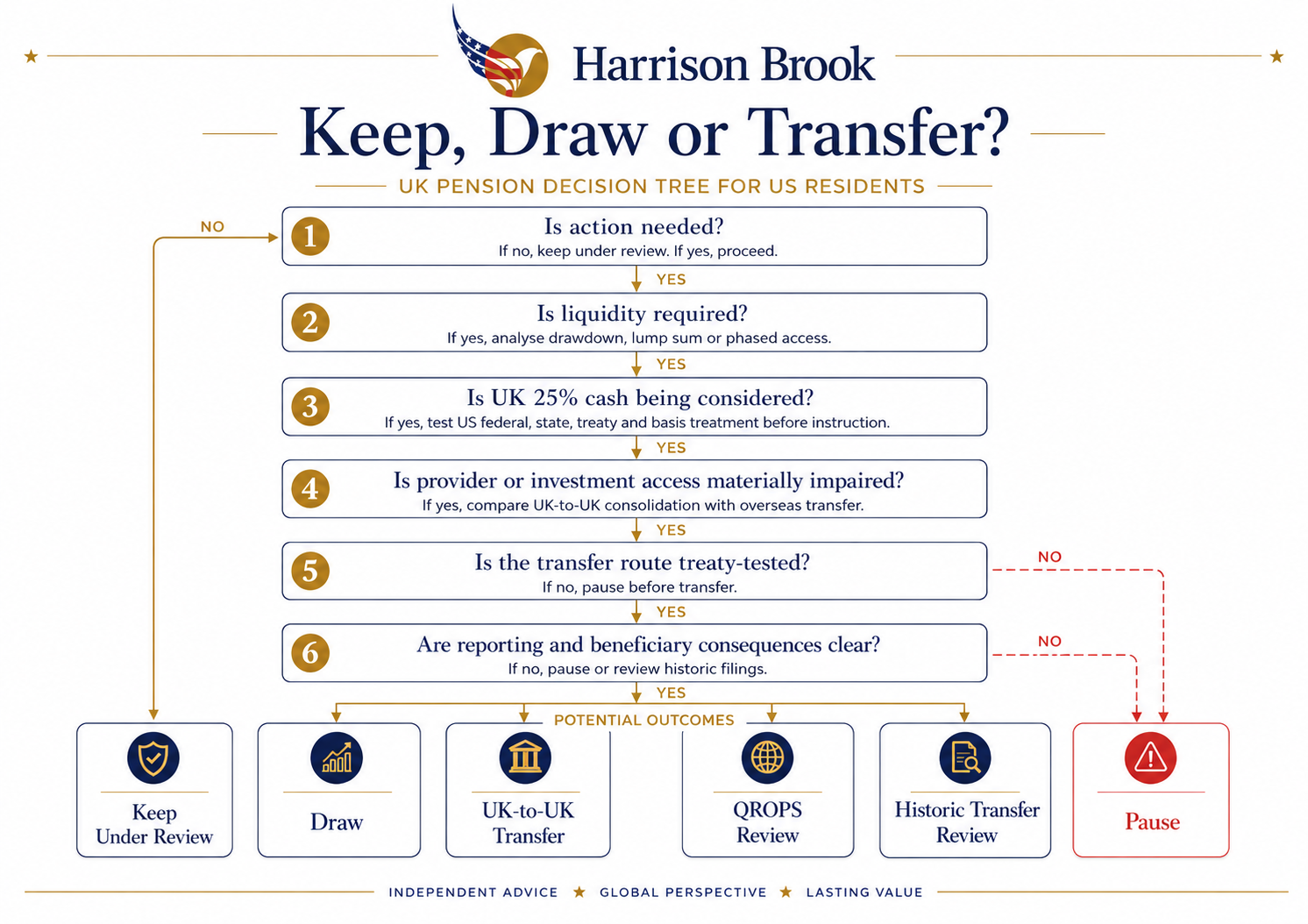
A transfer review should begin with the reason for leaving the current structure, then test whether the proposed route improves your position after UK charges, US tax, treaty classification, reporting, investment access and beneficiary outcomes are considered.
For the technical transfer analysis, see [QROPS for US residents]. For treaty treatment of pension payments and lump sums, see [Articles 17 and 18 of the UK–US treaty].
4. Fourth Filter: Family, Estate Planning and Future Mobility for US Residents with UK Pensions
For substantial UK pension assets, the keep, draw or transfer decision is often decided outside the pension itself.
Family, estate and mobility facts can change the answer. A pension may look efficient for income tax but inefficient for succession. A transfer may appear administratively attractive but create reporting or beneficiary problems. A drawdown strategy may provide useful liquidity but bring assets into a more exposed personal estate. A decision that works while you are US-resident in one state may look different after a move to another state or another country.
Beneficiary nominations should therefore be reviewed alongside wills, trusts, matrimonial planning, spouse status, children’s residence, liquidity needs and the family’s wider investment structure. A pension nomination that made sense when you lived in the UK may not be appropriate after US residence, remarriage, divorce, children moving jurisdictions, or a major liquidity event.
The UK inheritance tax treatment of pensions is also changing. From 6 April 2027, most unused pension funds and pension death benefits are expected to be brought within the value of the deceased’s estate for UK inheritance tax purposes. This is particularly relevant following the abolition of the UK’s traditional domicile-based tax regime and the move towards a residence-based framework, which may alter how internationally mobile families assess their UK inheritance tax exposure. The detailed implementation should be checked before publication and before any planning step, but the direction of travel is clear: pensions can no longer be treated uncritically as outside the estate for long-term UK succession planning.
For US-connected families, this interacts with a separate US estate tax system. US citizenship, domicile for US estate tax purposes, green card history, spouse citizenship, asset situs and treaty position may all matter. A UK pension decision should not be made in isolation from those facts.
Non-US spouse planning can be particularly sensitive. A structure that is efficient between two UK spouses may not operate the same way where one spouse is a US citizen, the other is not, and beneficiaries live across different jurisdictions. Similarly, children resident in the United States, the United Kingdom or elsewhere may face different reporting and tax consequences when receiving inherited pension benefits or drawn assets.
Future mobility is equally important. You may leave the US. You may move from California to Florida, Texas or New York. You may return to the UK. You may relocate to Portugal, the UAE, Switzerland, Singapore or another jurisdiction. You may relinquish a green card. You may sell a business before moving. Each of those events can affect the timing and desirability of pension withdrawals, transfers and beneficiary planning.
For internationally mobile families, the best answer may be temporary: keep for now, draw later, transfer only if the future residence position becomes clearer.
When Pausing a UK Pension Transfer or Withdrawal Is the Most Sophisticated Decision for a US Resident
Pausing is often mistaken for indecision. In cross-border pension planning, it can be a disciplined outcome.
Pause where residence is uncertain. Pause where the treaty position has not been documented. Pause where US reporting history is incomplete. Pause where contribution and basis records are missing. Pause where beneficiary nominations do not reflect current family reality. Pause where a business sale, divorce, liquidity event, relocation, green card change or estate restructuring is pending.
Pause also where the transfer analysis relies on old QROPS assumptions. The UK overseas transfer regime has changed over time. US reporting practice has evolved. IRS attention to Malta pension arrangements and foreign retirement structures has increased. An overseas transfer that was marketed as straightforward several years ago may deserve a fresh review before further distributions, onward transfers or beneficiary changes are made.
This is not an argument for paralysis. It is an argument against irreversible pension action based on incomplete facts.
Scenario box: The entrepreneur sale year
A UK pension holder is US-resident. In the same tax year, they expect a business sale, RSU vesting and a major liquidity event. They are also considering taking UK 25% pension cash and reviewing a QROPS transfer.
The review should not begin with the pension provider’s transfer forms. It should begin with the year’s total income profile, US federal and state residence, treaty position, pension basis, transfer history, beneficiary nominations, estate plan, spouse status, future residence and currency needs.
In that fact pattern, drawing or transferring in the same year as the liquidity event may be inefficient. But deferring may also carry opportunity cost if future residence or death-benefit treatment changes. The answer depends on sequencing.
Where family, residence or liquidity is likely to change, pausing can be the most disciplined decision. The planning priority is to avoid an irreversible pension step before your tax residence, beneficiary design and future jurisdictional position are known.
For the family and estate dimension of UK pensions in the US, see [holding a UK pension while living in the United States]. If lump-sum timing is affected by residence, see [UK pension 25% tax-free cash and the US treaty]. If a historic QROPS or future transfer is being considered, see [foreign trust reporting risks for overseas pension transfers].
5. The Keep, Draw, Transfer or Pause Framework for UK Pensions in the US
A useful UK pension decision framework should produce one of several outcomes. It should not force every case towards transfer, drawdown or inaction.
The framework below is designed to help you identify which path is most likely to apply before any pension instruction is submitted.
Keep where the UK structure remains viable, reporting is manageable, provider access is workable, there is no immediate cash need, investment governance is acceptable, beneficiaries are current and future residence does not undermine the strategy.
Draw where liquidity is needed, the tax year is manageable, the UK 25% pension commencement lump sum has been analysed under US rules, phased access fits the retirement plan, and the effect on the wider estate is understood.
Transfer where the current structure is genuinely unsuitable and the proposed route is technically supportable after UK transfer charges, US domestic tax, treaty classification, reporting obligations, costs, investment access and beneficiary outcomes have been reviewed.
Consolidate in the UK where the problem is administration, provider access, scheme fragmentation or investment implementation, and a UK-to-UK move can improve governance without introducing unnecessary third-country complexity.
Review historic QROPS where Malta or another third-country scheme was used, treaty claims were made, distributions are approaching, US filings may have been incomplete, or the member’s residence has changed since transfer.
Pause where facts are incomplete, residence is changing, reporting is unresolved, major liquidity events are pending, beneficiary planning is unclear, or the proposed action would be difficult to reverse.
The value of the framework is not that it produces a universal answer. It prevents the wrong question from driving the outcome.
The Evidence to Gather Before Any UK Pension Instruction
Before requesting a transfer, lump sum, drawdown or consolidation, gather the evidence. The quality of the decision depends on the quality of the record.
You should understand the pension scheme type, provider terms, current investment restrictions, transfer value, transfer history, crystallisation history, contribution history, employer contributions, personal contributions, historic tax relief, potential basis records, and any previous advice received.
You should also know your current US tax status. Are you a US citizen, green card holder, substantial presence taxpayer or non-resident alien? What is your state residence? Have you claimed treaty relief before? Have foreign pension interests, foreign accounts or foreign trusts been reported where required? Are there historic gaps?
Family information is equally important. Who is nominated as beneficiary? Is the spouse a US citizen? Where do children live? Are there trusts, prenuptial arrangements, divorce issues, blended family concerns or liquidity needs? Do wills and pension nominations point in the same direction?
Finally, future mobility should be documented. Are you likely to remain in the United States? Move state? Return to the UK? Relocate elsewhere? Sell a business? Retire abroad? Relinquish a green card? These are not peripheral facts. They may decide whether keeping, drawing, transferring or pausing is most appropriate
If you are unsure which category applies to your situation, a structured review can often save significant time, cost and complexity later. Harrison Brook offers complimentary introductory consultations for US residents with UK pensions, allowing you to discuss your circumstances with a cross-border specialist before making any irreversible decisions. Whether you are considering keeping a pension in the UK, taking benefits, consolidating schemes or reviewing a potential transfer, an initial conversation can help clarify the options and identify the key tax, reporting and planning issues that deserve further analysis.
Keep, draw, transfer or pause
| Path | When it may fit | Main risks | Evidence needed |
| Keep | UK pension remains viable, no immediate liquidity need, reporting understood | Passive neglect, outdated beneficiaries, future tax surprises | Scheme terms, reporting history, beneficiary nominations, withdrawal options |
| Draw | Liquidity required, retirement income needed, phased access fits plan | UK tax-free cash may not be US tax-free; timing may clash with other income | Tax residence, state residence, treaty position, basis records, income calendar |
| UK-to-UK transfer | Administration, provider or investment issues can be solved within the UK system | US review still required; provider restrictions may remain | Current provider terms, receiving scheme terms, transfer history, US reporting position |
| QROPS or third-country transfer | Current structure unsuitable and future residence or governance supports overseas review | UK transfer charge, treaty break, US tax, foreign trust reporting | UK transfer charge analysis, treaty classification, receiving scheme documents, reporting review |
| Review historic QROPS | Previous Malta or overseas transfer, distributions approaching, filings uncertain | Prior treaty claims, foreign trust reporting gaps, unexpected distribution treatment | Transfer date, scheme jurisdiction, US filings, distribution history, advice records |
| Pause | Residence, reporting, liquidity or family facts incomplete | Opportunity cost, but avoids irreversible error | Residence plan, liquidity events, beneficiary design, missing pension records |
For clients with meaningful UK pension assets and US exposure, the practical next step is usually to assemble the evidence before deciding on action. The pension instruction should come after the framework, not before it.
FAQs: UK Pensions for US Residents
Should a US resident keep a UK pension in the UK?
Often, yes. Keeping a UK pension in the UK can be sensible where the structure remains workable, reporting is understood, provider access is acceptable and no transfer-specific advantage has been identified. It should still be reviewed rather than ignored. A UK pension held by a US resident is a cross-border asset, not a dormant account.
Should I take the UK 25% tax-free cash while living in the US?
Not without US analysis. UK tax-free treatment does not automatically determine US federal or state tax treatment. The position may depend on your US tax status, state residence, treaty claim, saving clause exposure, contribution history, basis records and wider income in the same tax year. See [UK pension 25% tax-free cash and the US treaty].
Should a US resident transfer a UK pension to a QROPS?
Only after UK transfer charges, overseas transfer allowance, US treaty treatment, domestic tax rules, foreign trust reporting, future residence and beneficiary consequences have been reviewed. A QROPS may be appropriate in some cases, but it should not be the default starting point. See [QROPS for US residents].
Is doing nothing with a UK pension a good option?
It can be. But “doing nothing” should mean informed retention, not neglect. You should understand the current structure, reporting position, beneficiary nominations, investment access, provider restrictions, withdrawal options and future residence implications.
What should I review before making a UK pension decision as a US resident?
Review pension type, provider terms, transfer history, crystallisation history, contribution and basis records, US citizenship or green card status, state residence, prior US reporting, beneficiary nominations, spouse and family residence, future mobility, liquidity needs and other major income events.