
For US residents with UK pension assets, the old QROPS conversation is largely over.
That does not mean QROPS has disappeared as a UK pension transfer category. It has not. Nor does it mean every historic QROPS transfer was defective when made. Some were implemented in a different regulatory and treaty environment, and some may have had a coherent planning rationale at the time.
But for a US citizen, green card holder or US tax resident now considering what to do with a UK pension, the planning conclusion should be clear: a third-country QROPS is no longer a defensible default route.
The reason is not simply that UK rules have tightened, although they have. The more important reason is that the IRS has addressed the treaty distinction directly. A transfer from a UK pension to another UK pension is not the same as a transfer from a UK pension to a pension scheme established in a third country. A third-country pension scheme, such as one established in Malta, is not a pension scheme established in the United Kingdom or the United States for purposes of the UK–US treaty definition. The IRS therefore states that such a transfer could be treated as a taxable distribution for US purposes.
That is the critical point.
A transfer can preserve UK pension logic while breaking US treaty logic.
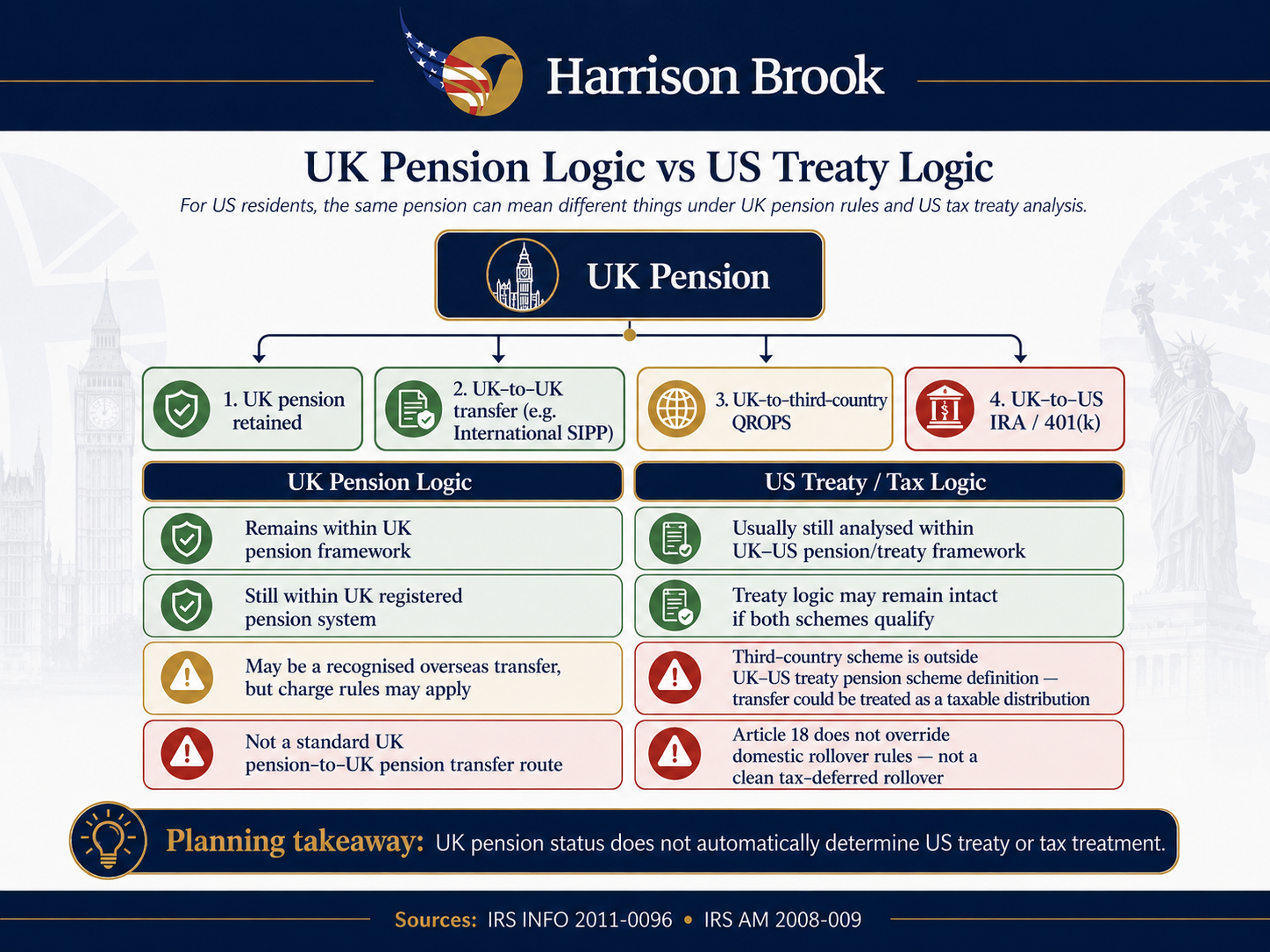
For many affluent US-connected families, that makes QROPS unattractive before the investment discussion even begins. If the transfer itself may be treated as a distribution, the client has not moved a pension in any meaningful US tax sense. They may have triggered a tax event, introduced a foreign trust or foreign asset reporting problem, and moved the asset into a structure that no longer sits comfortably inside the UK–US treaty framework.
The same discipline applies to the other common misconception: transferring a UK pension into a US IRA or 401(k). In practice, this is not possible without first taking a distribution from the UK pension. That means the transaction cannot be treated as a straightforward pension-to-pension transfer in the way many clients assume. The IRS has also made clear that Article 18 of the UK–US treaty does not override US domestic rollover rules. A UK pension does not become eligible for US tax-deferred rollover treatment merely because it is a pension.
The practical planning universe is therefore narrower than many clients expect. For most US residents with substantial UK defined contribution pension assets, the defensible answer is usually not QROPS, and it is usually not a US IRA or 401(k). It is to retain the pension within the UK pension system, often through an appropriate International SIPP, and manage the US tax, reporting, investment, withdrawal and beneficiary issues within that framework.
That is less dramatic than the old QROPS narrative. It is also more robust.
This article should be read alongside our broader guide to UK pension assets and US residence, which explains how tax residence, treaty treatment, pension governance, investment access and beneficiary planning interact for US-connected clients.
QROPS for US Residents: A UK Pension Transfer Status, Not IRS Approval or US Tax Recognition
A Qualifying Recognised Overseas Pension Scheme is a UK pension transfer concept. It tells us something about whether a non-UK pension scheme can receive a transfer from a UK registered pension scheme without the transfer automatically being treated as an unauthorised payment under UK pension tax rules.
It does not tell us how the IRS will tax the transaction.
That distinction is the foundation of the entire article. HMRC recognition is not US recognition. QROPS status is not an IRS classification. A QROPS is not a US qualified plan. It is not an IRA. It is not a 401(k). It is not a treaty-approved rollover vehicle. It is not a reporting-free structure.
For US persons, this matters because the US tax system does not simply accept the foreign label applied to an arrangement. It asks different questions. Is the transfer a distribution? Does US domestic rollover law apply? Does the UK–US treaty protect the transaction? Is the receiving structure established in one of the contracting states? Is it a foreign trust for US purposes? Does Form 8938 apply? Is FBAR reporting relevant? Are Forms 3520 or 3520-A in point? Is a treaty-based return position being taken? Is the arrangement within a category the IRS has already scrutinised?
Those questions are separate from the UK transfer analysis.
This is why older QROPS material can be misleading. Much of it starts from the UK-side question: can the pension be transferred overseas? The answer is often yes, of course it can. UK pension rules may permit the transfer, and the receiving arrangement may be capable of accepting it. But that does not answer the question that matters most for a US resident. The better question is: what is the US tax character of the transfer?
Where the receiving scheme is in a third country, the answer can be deeply unattractive. The IRS has expressly distinguished between transfers within the UK pension system and transfers to a pension scheme established outside the UK and US. That distinction undermines the traditional QROPS proposition for US-connected clients.
A UK pension left in the UK remains within the UK pension framework. A UK-to-UK transfer, such as a transfer to a suitable SIPP, is stated by the IRS to preserve the broad UK–US treaty architecture, provided the schemes qualify as pension schemes under the treaty. A UK-to-third-country QROPS transfer does something different. It moves the asset into a structure that may be a pension under local law but is not a UK pension scheme for purposes of the UK–US treaty.
That is where the planning risk becomes structural rather than administrative.
The receiving scheme may be entirely real. It may be regulated locally. It may be capable of receiving UK pension transfers under UK rules. It may appear on historic QROPS materials. None of that proves that the IRS will treat the transfer as tax-neutral.
For US residents, the word “pension” is not enough. The treaty route matters more than the label.
The IRS Position on Third-Country QROPS Transfers for US Residents and UK Pension Holders
One of the most central authorities on this issue is IRS INFO 2011-0096.
The letter considers transfers involving pension funds and addresses the UK–US treaty analysis directly. It explains that where a US resident is a member of a pension scheme established in the United Kingdom, a transfer of income earned by that UK pension scheme to another pension scheme established in the United Kingdom would not be taxed currently, provided each scheme qualifies as a pension scheme under the treaty.
That is the UK-to-UK point.
The IRS then draws the line. A pension scheme established in a third country, such as Malta, would not be a pension scheme within the meaning of the UK–US treaty definition because it is not established in one of the two contracting states: the United Kingdom or the United States. Therefore, if the transfer is to a pension scheme established in a third country rather than another UK pension scheme, the transfer could be treated as a distribution taxable as income.
That is the sentence that changes the QROPS conversation.
For the deeper treaty analysis behind this point, including how Article 17, Article 18 and the saving clause interact for UK pension holders in the United States, see our separate guide to UK pension treaty treatment under Articles 17 and 18.
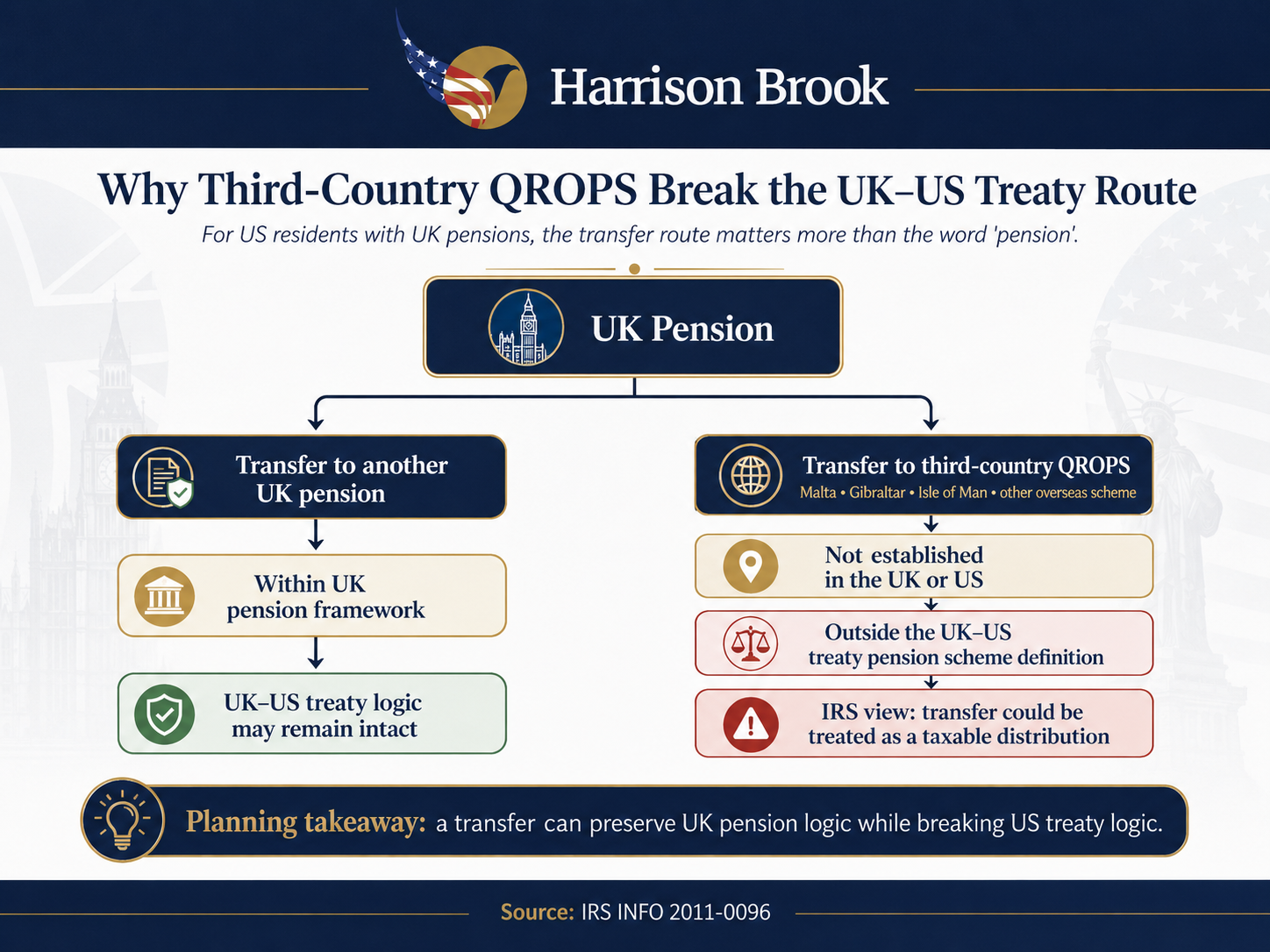
A US-resident taxpayer does not need the IRS to say every possible third-country transfer is automatically taxable in every possible fact pattern for the planning conclusion to be clear. A transfer that the IRS says could be treated as a taxable distribution should not be marketed, recommended or relied upon as a clean pension transfer. For substantial pension values, that level of uncertainty is enough to defeat the planning case unless an exceptionally specific and well-documented analysis supports the transaction.
This is especially important because many QROPS cases involve large pre-tax pension balances. If the transfer is treated as a distribution, the taxable amount may include pre-tax contributions and untaxed pension growth. For a high-income US resident, that can create a material federal income tax exposure. State income tax may also need review. Net investment income tax, foreign tax credit availability, timing mismatches and reporting penalties may further complicate the position.
The mistake is to treat this as a narrow treaty technicality. It is not. It changes the economics.
A UK pension transfer of £1m, £2m or £5m is not a small administrative movement. If the transfer is treated as a distribution, the result can be a very substantial US taxable event. For high-income taxpayers, ordinary income may be taxed at federal rates of up to 37% under current law. Ignoring exchange-rate effects, deductions, credits and other individual circumstances, a £1m taxable distribution could therefore create a federal tax bill of up to approximately £370,000, a £2m distribution up to approximately £740,000, and a £5m distribution up to approximately £1.85m. These figures exclude any state income taxes and are illustrative only, but they demonstrate why the tax treatment of the transfer must be analysed before any transfer instruction is signed.
For that reason, a US-resident client considering QROPS should normally start from a presumption against transfer. The burden of proof should sit with the proposed transfer, not with the decision to retain the pension in the UK.
That reverses the old QROPS sales narrative. The old narrative asked why the client would leave the pension in the UK. The modern US-connected analysis asks why the client would expose themselves to a third-country treaty break.
In most cases, they should not.
Unsure whether to keep your UK pension where it is, transfer to an International SIPP, or review an existing QROPS? Book a meeting with one of our qualified cross-border advisers for personalised guidance based on your UK and US tax position. Our cross-border, FCA & SEC regulated advisers at Harrison Brook specialise in UK–US pension planning.
UK QROPS Rule Changes: Why Older QROPS Advice Is No Longer Reliable for US Residents
The US treaty issue is enough to make QROPS unattractive for many US persons. The UK rule changes make older material even less reliable.
From 9 March 2017, certain transfers to and from QROPS became subject to the 25% overseas transfer charge unless an exclusion applies. This was a major change to the economics of overseas pension transfers. It meant that QROPS could no longer be analysed simply as a flexible overseas destination for UK pension assets. The transfer charge became a front-end issue.
The position changed again from 6 April 2024 with the introduction of the Overseas Transfer Allowance (OTA). The OTA replaced the previous lifetime allowance-based framework for assessing certain overseas pension transfers and created a new limit on the amount that can be transferred overseas without triggering an overseas transfer charge. For larger pension values, this introduced an additional layer of complexity and potential tax exposure that must be considered alongside the existing overseas transfer charge rules.
The position tightened again from 30 October 2024, when the exclusion for transfers to QROPS established in the EEA or Gibraltar was removed. Historically, many QROPS discussions relied on EEA or Gibraltar structures. That logic is now stale for new transfers unless the fact pattern falls within a narrow transitional window. The old exclusion could remain relevant only where the transfer had been requested before 30 October 2024 and completed before 30 April 2025.
From 6 April 2025, EEA overseas pension schemes and recognised overseas pension schemes became subject to requirements aligned with the rest of the world. The practical effect is that the old EEA/Gibraltar distinction no longer carries the same planning value it once did.
For a US resident, this produces a layered problem.
First, the UK may impose a 25% overseas transfer charge unless an exclusion applies.
Second, the overseas transfer allowance can create additional charge exposure on larger pension values.
Third, even if the UK transfer is recognised, the IRS will treat the movement to a third-country scheme as a taxable distribution.
Fourth, the receiving arrangement will create recurring US reporting obligations.
Fifth, future residence changes may disturb assumptions made at the time of transfer.
That is not an enhancement to the planning outcome. It is an accumulation of interlocking risks: potential UK transfer charges, possible adverse US tax treatment at the point of transfer, ongoing reporting complexity, and future uncertainty if the client’s residence or circumstances change. Viewed holistically, the structure introduces additional layers of tax, regulatory and administrative exposure without delivering a commensurate planning advantage.
Older QROPS advice should therefore be treated with caution. Some legacy advice may have been reasonable in its own time, depending on the facts. But it should not be recycled into current advice for US persons without full re-testing. The UK transfer charge regime, the EEA/Gibraltar changes, the Malta treaty developments, IRS scrutiny of offshore pension structures and US foreign trust reporting rules have changed the environment materially.
A client should be particularly cautious where the recommendation is based on any of the following propositions:
- the scheme is on an HMRC list, so the IRS must accept it;
- the receiving arrangement is still a pension, so the transfer is not taxable;
- Malta, Gibraltar or another overseas jurisdiction has a favourable pension regime;
- the UK–US treaty protects all pension transfers;
- QROPS offers international flexibility without a material US tax cost;
- the client can solve the problem later through reporting.
Each proposition is either incomplete or wrong for US-connected clients.
The relevant planning question is no longer whether QROPS is available. The question is whether QROPS remains defensible after the US tax treatment is modelled. In most serious US-resident cases, that answer will be no.
Can I Transfer My UK Pension to the US? Why a 401(k) or IRA Usually Does Not Solve the Problem
Once a client understands the QROPS issue, the next question is often whether the UK pension can be transferred into a US retirement account.
That answer is no.
A US IRA or 401(k) is not a receiving vehicle for a UK pension transfer. A UK pension is not a US eligible retirement plan, and the fact that both arrangements are used for retirement does not make them mutually portable. The only way assets generally move from a UK pension into a US retirement account is through a distribution from the UK pension first. At that point, the issue is no longer a tax-deferred pension transfer. It is a distribution, and for substantial pension values that can create a very significant US tax liability.
The IRS addressed this point in AM 2008-009. The question was whether a US resident could rely on Article 18(1) of the UK–US treaty to make a tax-deferred rollover distribution from a UK pension scheme to a US retirement plan where the distribution would not qualify as an eligible rollover distribution under US domestic law. The IRS conclusion was direct: “No.” Article 18 does not override the requirement that the distribution must qualify under the domestic rollover rules.
That is the practical end of the UK-to-US rollover idea for most clients.
This is important because the UK-to-US transfer misconception is attractive. It feels intuitive. If QROPS is problematic because the receiving scheme is in a third country, why not move the pension into the US system instead? The client lives in the United States. Their tax reporting is in the United States. Their investment adviser may be in the United States. Their retirement spending may be in dollars. A US IRA or 401(k) sounds administratively cleaner.
But retirement systems are not interchangeable. The US domestic rollover rules are prescriptive. Treaty language does not create an independent rollover right where domestic law does not allow one. A transfer from a UK pension to a US plan may therefore be treated as a taxable distribution rather than a tax-deferred rollover.
That creates a second blocked exit.
The third-country QROPS route is exposed because the receiving scheme is not established in the UK or US for UK–US treaty purposes. The US IRA or 401(k) route is exposed because the transfer does not satisfy US domestic rollover requirements merely by invoking Article 18.
For US residents with UK pensions, this is the uncomfortable but necessary conclusion: the pension usually cannot be cleanly exported into the overseas structure they might prefer. It needs to be governed properly where it already belongs – within the UK pension system.
Why the International SIPP Is Usually the More Defensible Route
An International SIPP is not a magic answer. It does not make the UK pension a US pension. It does not eliminate US reporting. It does not make withdrawals automatically tax-free in the United States. It does not remove the need for coordinated UK and US advice.
Its advantage is more sober: it keeps the pension inside the UK pension regime while improving the governance, investment access and administration of the arrangement for a non-UK-resident member.
That is why it is usually the practical planning answer for US residents with UK defined contribution pension assets.
The client may have an old UK personal pension, workplace defined contribution scheme or legacy SIPP that is no longer fit for purpose. It may have limited investment options, poor currency capability, restrictive drawdown rules, weak beneficiary functionality, limited adviser access, inadequate reporting, or administrative discomfort with a US-resident member. Those are real problems. They should be solved.
But they do not require a third-country QROPS, nor do they require an attempted transfer into a US IRA or 401(k).
A suitable International SIPP can often address the governance issue without breaking the UK pension framework. The pension remains a UK registered pension. The transfer is UK-to-UK rather than UK-to-third-country. The adviser can then focus on the real planning questions: US tax residence, treaty treatment of growth and distributions, basis reconstruction, reporting, investment architecture, currency exposure, withdrawal sequencing, beneficiary nominations and estate planning.
That is a better conversation.
For high-net-worth clients, the International SIPP should not be positioned as a product. It should be positioned as a governance structure. The objective is not simply more funds or lower costs. The objective is to preserve the pension’s jurisdictional character while making it workable for a US-connected life.
A good International SIPP review should consider:
- whether the existing UK pension is defined contribution, defined benefit or hybrid;
- whether safeguarded benefits, guarantees or protected tax-free cash exist;
- whether a transfer would require UK regulated pension transfer advice, which it does where safeguarded benefits above the relevant threshold are being transferred;
- whether the receiving SIPP can accept a US-resident member;
- whether the investment platform can accommodate US tax-sensitive implementation;
- whether the client needs sterling, dollar or multi-currency management;
- whether US reporting data can be reconstructed and maintained;
- whether beneficiary nominations remain suitable;
- whether post-2027 UK inheritance-tax changes affect the death-benefit strategy;
- how withdrawals will be coordinated between UK and US tax years.
This is where the planning value sits. Not in moving the pension offshore, but in making the UK pension governable for a US-resident member.
The negative qualification also matters. An International SIPP is not automatically appropriate. Defined benefit (also known as final salary) pensions require particular caution. Guaranteed annuity rates, protected tax-free cash, scheme-specific protections, low-cost institutional pricing, employer subsidies and valuable death benefits may all argue against transfer. Some providers may not accept US residents. Some investment platforms may be unsuitable for US persons. Some clients may be better served by leaving the pension where it is.
But where a transfer is appropriate, the safer direction is usually within the UK pension system rather than outside it.
For clients who have ruled out QROPS and cannot transfer cleanly into a US IRA or 401(k), the remaining question is more practical: should the UK pension be left where it is, consolidated into an International SIPP, or drawn from over time? We will examine that decision in our private-client framework on our next post.
Legacy QROPS Holders in the US: Why a QROPS Review Is Essential Before Taking Pension Benefits or Withdrawals
Some readers will already have transferred to a QROPS.
They should not assume the issue is settled.
A historic QROPS transfer may have been made before the client became US resident. It may have been made under older UK rules. It may have been based on advice that was considered conventional at the time. It may have been routed through Malta, Gibraltar, the Isle of Man or another overseas pension jurisdiction. It may have been reported consistently for years. None of that means the structure should be ignored now.
In fact, for many US-connected individuals, the most important question is not whether the transfer was reported, but whether the transfer itself should have been treated as a taxable distribution for US tax purposes at the time it occurred. If the IRS view is that the transfer constituted a distribution, the underlying tax issue does not disappear simply because the transaction was omitted from a return, reported differently, or never examined. The exposure may remain open for review depending on the facts, the filings made, and the applicable limitation periods.
That does not mean every historic QROPS transfer automatically creates a current tax liability. The analysis is highly fact-specific and depends on residence, timing, treaty positions, reporting history, the nature of the receiving arrangement, and the advice relied upon when the transfer occurred. However, clients should be cautious about assuming that a completed transfer is beyond challenge simply because it happened years ago.
Where there is concern that a transfer may not have been reported consistently with the IRS position, obtaining specialist US tax advice should be a priority. In some cases, remedial action may be available. The appropriate approach will depend on the circumstances and may involve reviewing historic returns, assessing disclosure options, reconstructing records, evaluating reporting obligations, and determining whether corrective filings are advisable. The correct remedy is highly dependent on the facts and should not be approached casually.
The financial stakes can be substantial. Large UK pension transfers often involve significant pre-tax retirement assets, and if a transfer is ultimately treated as a taxable distribution, the resulting tax exposure can be material. Interest may accrue over time, and in some situations penalties may also need to be considered. The combination of tax, interest and potential penalties can become severe enough to affect broader retirement, investment and estate-planning objectives.
For that reason, legacy QROPS holders should approach the issue with care rather than complacency. The objective is not to assume every transfer was taxable, but to recognise that the IRS has already identified third-country pension transfers as a potential taxable-distribution issue. In a worst-case scenario, the IRS could conclude that the original transfer was taxable when made, with resulting tax, interest and potentially penalties accumulating over time. The practical goal is therefore to establish what happened, determine the correct US tax treatment, understand any remaining exposure, and evaluate whether a proactive solution is available before the issue is identified through an audit, information reporting or another IRS review process.
The review should be especially careful before any of the following events:
- the client becomes US tax resident;
- the client takes a lump sum or periodic distribution;
- the client transfers from one QROPS to another;
- the client changes country of residence during a relevant period;
- the client updates beneficiary planning;
- the client amends historic US filings;
- the client dies while holding substantial unused pension assets;
- the family seeks to integrate the QROPS into wider estate or succession planning.
The purpose of review is not to create alarm. It is to prevent a second error.
The key questions are practical. Was the client a US person at the time of transfer? That distinction is critical. A British expatriate who established a QROPS before becoming US resident may present a very different analysis from a US citizen or other US person who was already subject to IRS taxation on worldwide income and assets when the transfer occurred. Was the receiving scheme established in a third country, such as Malta? Was treaty treatment claimed, whether under the UK–US treaty or, where relevant, the Malta–US tax treaty? Were Forms 3520 or 3520-A considered? Was Form 8938 filed where required? Was FBAR considered? Were distributions reported correctly? Is there a reportable-transaction issue, particularly for Malta-related arrangements? Does Rev. Proc. 2020-17 apply, and if so, to which reporting obligation and reporting year? Has the client retained records of contributions, basis, transfer value, residency status at the time of transfer, and scheme status?
That last point is often underestimated. Pension tax analysis depends heavily on records. Older UK schemes may not provide US-ready data. QROPS providers may not maintain information in the form a US tax adviser needs. If the client waits until the year of a large distribution, reconstruction may be difficult and expensive.
Legacy QROPS holders should therefore treat their existing structure as a file to review, not a conclusion to rely upon.
US Reporting Requirements for Foreign Pensions: Why a UK Pension Still Creates US Tax Filing Obligations
Even if a client retains a UK pension or moves to an International SIPP, US reporting does not disappear.
That is another reason QROPS should not be sold as a simplification. In many cases, it adds both reporting uncertainty and reporting complexity rather than removing them.
A US person with a foreign pension may need to consider Form 8938, FBAR, Forms 3520 and 3520-A, Form 8833, and in certain cases reportable-transaction analysis. The exact answer depends on the structure, account ownership, treaty position, trust classification, thresholds, distributions and reporting history.
Rev. Proc. 2020-17 is helpful, but it is not a blanket exemption. It provides relief from certain section 6048 foreign trust reporting obligations for eligible individuals with certain tax-favoured foreign retirement trusts. It does not eliminate Form 8938. It does not eliminate FBAR. It does not automatically apply to every foreign pension arrangement. It does not rescue a structure that fails the qualifying conditions. It should not be used as a slogan.
The main qualifying conditions are often overlooked. Broadly, Rev. Proc. 2020-17 applies only where the individual is an eligible individual and the arrangement is an eligible tax-favoured foreign retirement trust (or certain eligible tax-favoured foreign non-retirement savings trusts). In the retirement context, the trust generally must satisfy conditions such as:
- Being established, operated and regulated under the laws of a foreign jurisdiction.
- Receiving tax-favoured treatment in that jurisdiction.
- Being maintained principally to provide pension or retirement benefits.
- Having contributions, withdrawals and eligibility for benefits subject to government-imposed limitations or regulation.
- Being subject to annual information reporting requirements to the relevant foreign tax authorities.
The relief is also limited to the section 6048 reporting obligations covered by the revenue procedure; it does not exempt the taxpayer from other US reporting regimes. Whether a particular UK pension, SIPP, QROPS or other overseas arrangement satisfies these requirements requires a fact-specific analysis and should not be assumed merely because the arrangement is described as a pension.
For US residents with UK pensions, the reporting answer should be deliberately documented. A client should know which forms are being filed, which forms are not being filed, and why. That is especially important where a treaty position is being taken or where the pension has moved outside the UK.
It is also important where the pension is being retained primarily as a long-term family wealth and succession vehicle rather than as a source of retirement income. Some US reporting relief provisions depend on the arrangement being maintained principally to provide pension or retirement benefits. Where a pension is left largely untouched for inheritance, beneficiary or intergenerational planning reasons, advisers should be careful not to assume that every reporting exemption or favourable classification automatically applies. The facts, governing documents, benefit structure and actual use of the arrangement should all be reviewed.
The worst reporting position is informal confidence. “It is just a pension” is not a US filing analysis.
The Decision Framework for US Residents With UK Pensions
The modern decision framework is straightforward.
Do not start with QROPS.
Start with your tax residence, citizenship, pension type, transfer history, reporting position and long-term family plan.
For most US-connected clients, the routes can be assessed as follows:
| Route | Current planning view for US residents |
| Leave the UK pension where it is | Often the correct baseline if the existing scheme is suitable, cost-effective and administratively workable. |
| Transfer to an International SIPP | Often the most defensible route where the existing UK arrangement is unsuitable but the client should remain within the UK pension system. |
| Transfer to a third-country QROPS | Generally unattractive for US persons because of IRS treaty treatment, possible taxable distribution analysis, UK transfer charge risk and reporting exposure. |
| Transfer to a US IRA or 401(k) | Generally not available as a clean tax-deferred rollover because Article 18 does not override US domestic rollover rules. |
| Review a historic QROPS | Essential before distributions, further transfers, US residence changes, amended filings or estate planning decisions. |
This framework is not anti-planning. It is disciplined planning.
The client may still need investment improvement. They may need lower costs, better currency management, drawdown flexibility, clearer beneficiary nominations, access to institutional portfolios, or better cross-border reporting coordination. Those are legitimate objectives. But for a US resident, they are usually better addressed inside a UK pension arrangement than through a third-country QROPS.
The best planning question is therefore not: “Can I move my UK pension offshore?”
It is: “What is the most defensible UK pension structure for a US-connected life?”
For many clients, that answer will be an International SIPP. For others, it may be the existing UK scheme. For a smaller number, it may be no transfer at all until residence, tax and family facts become clearer. But it is rarely a new third-country QROPS.
Conclusion: The QROPS Era Has Largely Ended for US-Connected UK Pension Holders
For US residents with UK pensions, QROPS should no longer be presented as a mainstream solution.
The IRS has drawn the key distinction. A UK-to-UK pension transfer and a UK-to-third-country pension transfer are not the same for treaty purposes. A third-country pension scheme is not established in the United Kingdom or the United States. A transfer to that scheme can therefore be treated as a taxable distribution.
That is enough to change the planning posture.
At the same time, UK rules have become less favourable. The overseas transfer charge, the removal of the EEA/Gibraltar exclusion, the overseas transfer allowance and relevant-period monitoring all make QROPS less compelling on the UK side. Malta-related developments and foreign trust reporting risks make the US side even more sensitive.
Nor does the US system provide an easy alternative. A UK pension cannot generally be rolled into an IRA or 401(k) on a tax-deferred basis merely by invoking Article 18. The IRS has rejected that reading.
For US investors with UK pension assets, the answer is therefore more disciplined: keep the pension within the UK framework where possible, improve the structure where necessary, and coordinate the US tax, reporting, investment, withdrawal and beneficiary work around it.
In practice, that often means an International SIPP or another suitable UK pension arrangement. Not because it is perfect. Not because it removes complexity. But because it avoids the largest error in this area: trying to solve a UK pension governance problem by moving the asset into a structure the IRS does not treat as the client hoped.
For serious US-connected families, the modern pension transfer question is no longer “Which QROPS?”
It is “How do we govern the UK pension properly from the United States?”
FAQs
Can a US resident transfer a UK pension to a QROPS?
Possibly under UK pension rules, depending on the receiving scheme and transfer conditions. But that is not the important question. For US tax purposes, a transfer to a third-country QROPS can be treated as a taxable distribution. As a result, most QROPS providers have stopped actively offering QROPS solutions to US persons, and for most US residents new QROPS planning is no longer considered an attractive or practical option.
Did the IRS say third-country QROPS transfers can be taxable?
Yes. IRS INFO 2011-0096 states that a third-country pension scheme, such as one established in Malta, is not a pension scheme within the UK–US treaty definition because it is not established in the UK or US. The IRS states that a transfer to such a scheme could be treated as a taxable distribution.
Can a UK pension be transferred into a US IRA or 401(k)?
Usually not as a clean tax-deferred rollover. The IRS has stated that Article 18 of the UK–US treaty does not override US domestic rollover requirements. A UK pension is not automatically eligible for US rollover treatment simply because it is a retirement arrangement.
What is usually the better route for US residents with UK pensions?
For many clients, the better route is to retain the pension within the UK pension system, often through an appropriate International SIPP if the existing arrangement is unsuitable. The structure should then be coordinated with US tax reporting, investment management, withdrawal planning and beneficiary strategy.
Should historic QROPS transfers be reviewed?
Yes. Legacy QROPS arrangements should be reviewed before distributions, onward transfers, amended filings, residence changes or estate planning decisions. The fact that a transfer was completed years ago does not mean the US tax and reporting position remains comfortable.
